Religious
The friars' orchard
Before 1822
- OwnersRecollect friars
- ChurchOpened 1732
- StatusOutside the walls
Deciding made easy
Two questions, one way in
Say how you like to learn and how much of the neighborhood you want, and a tour appears with its starting price.
Your top pick
from $12
2 hours inside the cemetery with an English-speaking guide; buy the entrance ticket first.
Your top pick
from $59
2.5 hours in English with no more than 15 people.
Your top pick
from $75
2 hours for your group alone, cemetery ticket included as the listing says.
Your top pick
from $33
2.5 hours from Plaza San Martin; the cemetery visit is optional, at an extra fee.
Your top pick
from $93
2 hours around Recoleta with a short cemetery stop.
The history of Recoleta Cemetery runs from a friars' orchard outside the city to Argentina's virtual national pantheon, and it is still a working cemetery today.
Editorial team, recoletacemeterytour.click · Updated November 9, 2026 · A 7 min read
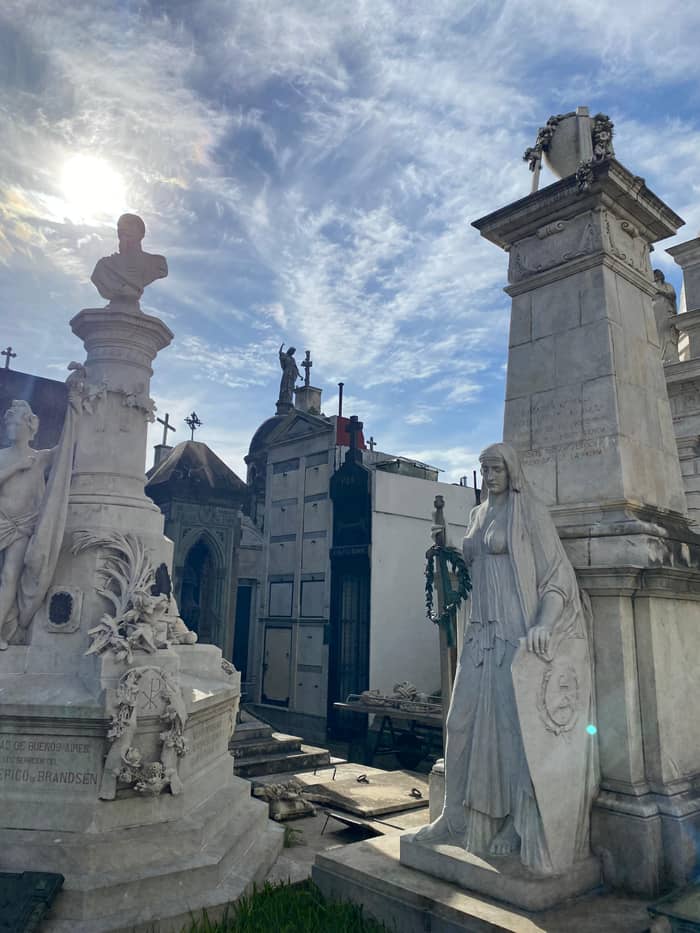
The history of Recoleta Cemetery begins with a religious order. It was the Recollect friars, settling here early in the 18th century, who gave the district its name.6 Their church, Our Lady of the Pillar, opened in 1732 and was declared a National Historic Monument in 1942;7 it still stands beside the cemetery gate.
The friars chose a site on the edge of the city, in keeping with their rule of retreat and seclusion, and planted an orchard behind their convent. That orchard is where the cemetery was later built, as the City of Buenos Aires explains.2 The convent building survives too, much altered, as today's Recoleta Cultural Centre.8
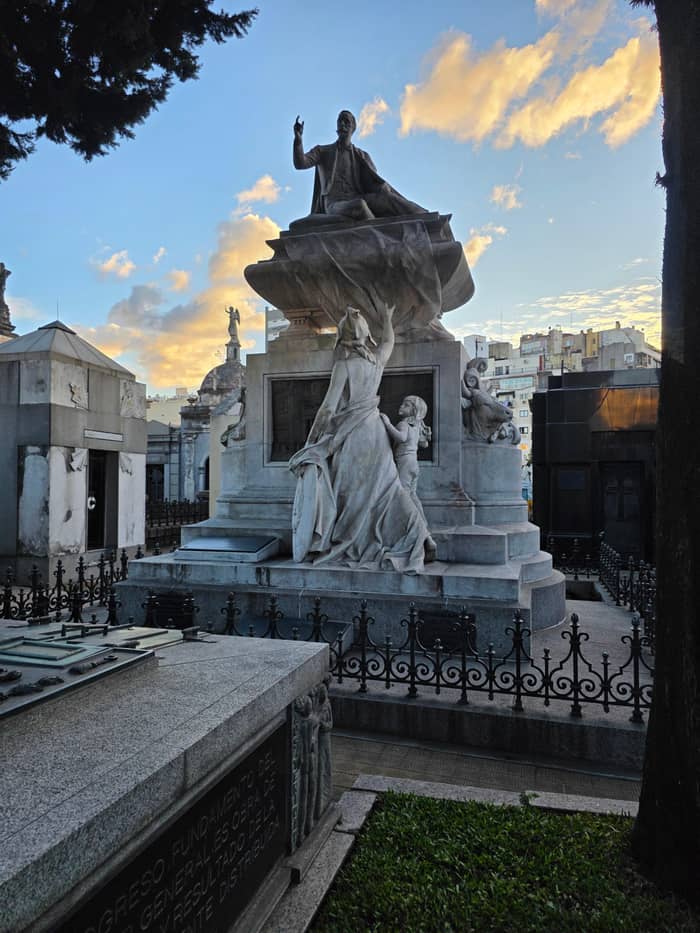
The friars' time ended with the church reforms of Bernardino Rivadavia's day, which took many religious properties into public hands. The convent passed to the State in 1822, after the reform of the church orders,9 and the national monuments commission records that the orchard was an area outside the city walls expropriated during those same reforms.10 The land was ready for a new purpose, and a growing city badly needed a burial ground away from its churches and crowded center.
Then and now
| Period | What changed | Source |
|---|---|---|
| Early 18th century | Recollect friars arrive | City tourism board |
| 1822 | Public cemetery opens | City of Buenos Aires |
| 1871 | Elite moves north after yellow fever | City tourism board |
| 1881 | Reform by Buschiazzo | Monuments commission |
| 1810 to 1860 | Simple Neoclassical tombs | Monuments commission |
| 1920s | Art Deco mausoleums | Monuments commission |
| Today | Burials continue | City of Buenos Aires |
Dates and descriptions from the City of Buenos Aires, its tourism board and the national monuments commission.6,1,12,3,19,14,5
When it opened in 1822, Recoleta became the city's first public burial ground, set out on a plan by Próspero Catelin, a French engineer.1 It was then called the Cementerio del Norte, the northern cemetery, designed by Catelin at the commission of Rivadavia, minister to Governor Martín Rodríguez.11 The new cemetery sat on what had been land beyond the city walls.10
Catelin was a busy man in those years. The tourism board notes that he also designed the Metropolitan Cathedral on Plaza de Mayo,17 and his plan for the cemetery set the grid of avenues and alleys that you still walk today. The commission calls Recoleta the oldest public cemetery of the city,18 and the regular plan is the first thing you notice from the central avenue.
The early graves were modest, and many of them are still there if you know where to look. Tombs of the half century to 1860 kept to the sober classical taste of the young republic,19 and the Meritorious Citizens pantheon gathers heroes of the May Revolution such as Cornelio de Saavedra and Deán Funes.20 The marble palaces that visitors photograph came much later, built over and around these first plain stones, so the oldest and newest tombs often share the same alley.
Key dates
Recoleta became fashionable because of an epidemic. After frequent cholera outbreaks and above all the yellow fever of 1871, the richest families of the south of the city moved north and settled this area, the tourism board explains.12 The same epidemic forced the city to build new cemeteries to cope with the number of deaths.13
One victim of that year lies here as a hero. Francisco Muñiz, a doctor, lost his life in 1871 caring for the fever's victims,24 and the commission remembers him as the pioneer of Argentine natural history.25 His later monument by Ettore Ximenes shows an allegorical figure holding the rod of Asclepius,26 a fitting tribute to a doctor who gave his life to his patients.
By the late 19th century the new residents of the district had adopted Recoleta as their family burial place.27 The definitive shaping of the neighborhood was the work of the city's first mayor, Torcuato de Alvear.28 The church, the cemetery and the former convent came to form one architectural ensemble rich in history.29
Eras
Religious
Before 1822
Civic
From 1822
Splendor
From the 1880s
The turning point came in 1881, when Alvear, the capital's first mayor, handed the cemetery's renewal to the architect Buschiazzo.3 It was part of an ambitious plan the mayor and his architect carried out together, which also included opening the Cementerio del Oeste, today's Chacarita, and the Avenida de Mayo.33
Buschiazzo gave the city's burial grounds classical gateways,30 and the columned entrance on Junín belongs to that idea of a dignified threshold. The reform turned a plain burial ground into a setting worthy of the families who were moving into the streets around it, and it set the stage for the building boom that followed.
Alvear himself stayed close to his work. His own resting place is the Alvear vault, drawn by Christophersen, shared with his father, General Carlos María de Alvear, and with the family of his son Marcelo T. de Alvear.31 It stands on our self-guided route, near the eastern wall, a short walk from the gate that his reform created. Pause there for a moment: few people have shaped a place and then come to rest inside it.
Hear the history
Compare guided tours of the cemetery.
Weigh up 3 options
Compare guided tours of the cemetery.
≈
View≈
View≈
ViewStarting prices on GetYourGuide, exchanged at the ECB reference rate. The booking page gives the exact price.
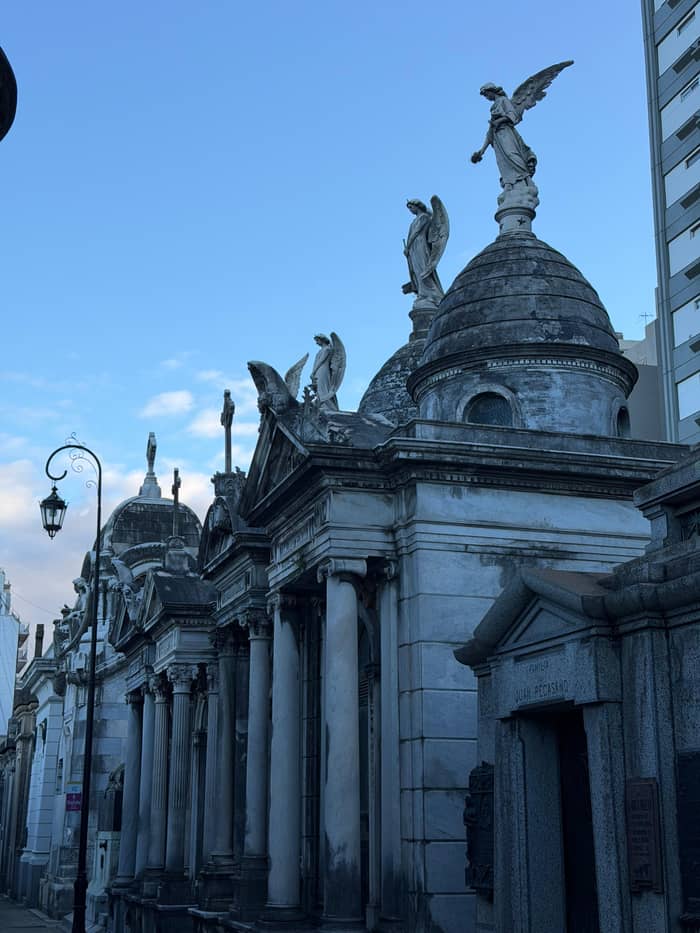
The turn of the century gave the cemetery its famous face, the one that fills postcards and phone screens today. The country was growing rich, and the tourism board describes the great families racing one another to build the grandest pantheon.34 The commission adds that they competed in height, with domes, small temples, peristyles and elaborate sculpture.35
European artists answered the call. Paris and Genoa set the fashion, the commission notes,36 and famous chisels came with it: Coutan made Avellaneda's monument in 1908,21 and Mercié signed Pellegrini's mausoleum, raised in 1913.22 In the 1920s a series of Art Deco mausoleums followed,14 adding a modern note to the marble streets.
Politics was carved into the stone too. The monument for the dead of the 1890 rising, drawn by Courtois in 1892,37 became in time the tomb of party leaders Alem, Yrigoyen and Illia.32 Monuments like this one show how the cemetery recorded the country's political battles as well as its private griefs. Our page on architecture and sculpture goes through the styles and the sculptors in detail.
Video
David Owens on YouTube · Playback files load only once you tap play.
Torcuato de Alvear, the capital's first mayor, commissioned the architect Juan Antonio Buschiazzo in 1881 to reform the cemetery.
History walk
Bit by bit, Recoleta turned into the nation's hall of honor, the commission writes, simply by gathering more historic graves than anywhere else.38 The commission itself took up the idea of a formal pantheon in 1939, and it returned in 1970 as the Altar de la Patria, but it was the cemetery that played the role.39
Declarations followed decade by decade. Brown was listed in 1946,40 Vernet in 198341 and Sáenz Peña not until 2011.42 The tally of nationally protected vaults now passes 90,43 and the cemetery as a whole was declared one in 2007.4 Each decree reflects the priorities of the government that signed it, so the list of protected tombs is itself a piece of history.
The most visited grave arrived late. Eva Peron, who died in 1952, was only laid in her family's vault after the coup of March 1976, following a long journey of her body that the Evita Museum documents.44,15,16 Her vault is now the most visited in the cemetery,45 and our page on her tomb tells her story in full.
Are people still buried in Recoleta Cemetery? Yes. The city's operations office for the cemetery is charged with arranging burials in graves, vaults, pantheons and niches under the rules in force,5 and a city office handles the registration, transfer and concessions of vaults.46 There is no cremation service on site.47
That is why the rules about respect matter. Families still own vaults and visit them, and you may see a burial or a family at a door during your visit. The cemetery is also a public heritage site: its own staff run free Spanish tours on the hour,23 and it counts more than 200 figures of Argentine history among its graves.48
Recoleta also has a sister cemetery with a different character. The tourism board calls Recoleta the more aristocratic necropolis, the one most tourists visit,49 while Chacarita, opened after the yellow fever of 1871 forced the city to build new cemeteries,13 became the resting place of other important figures, among them the tango singer Carlos Gardel.50 Together they tell the city's story from both ends, and a visit to each rounds out the portrait of Buenos Aires.
FAQ
Próspero Catelin drew the plan for what was the city's first public burial ground.1
The city's office for the cemetery arranges burials in vaults, pantheons, graves and niches.5
The neighborhood takes its name from their convent and church.6
Fleeing the 1871 epidemic in the south, wealthy households resettled here.12
It was declared a National Historic Monument in 2007.4
The cemetery offers no cremation service.47
Sources
Visiting Recoleta Cemetery? Ask a real person here.