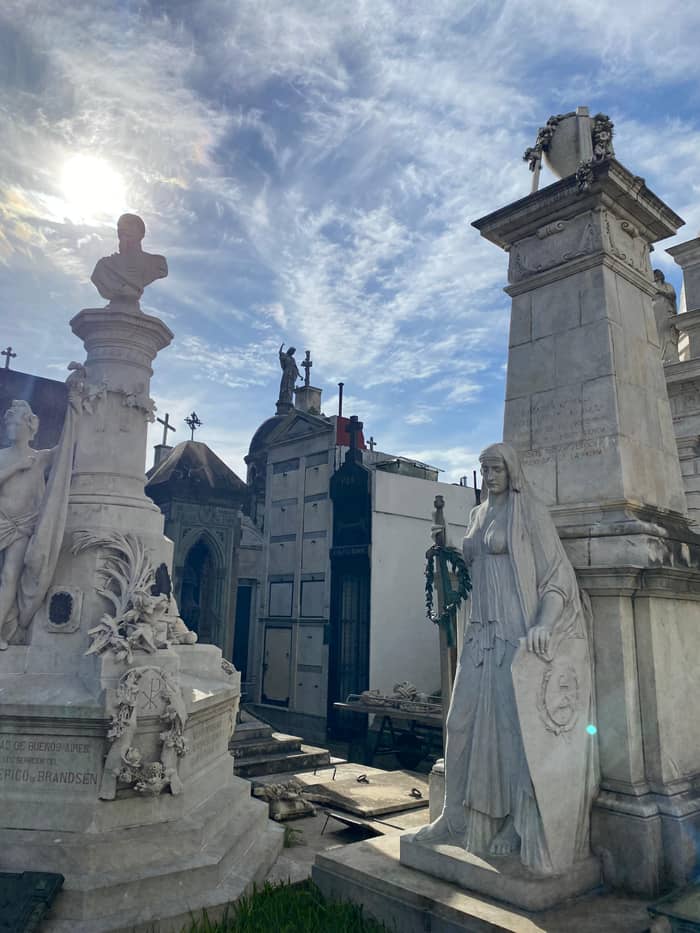
Her resting place
The Duarte vault
Inside the cemetery
- WhereA side passage
- ExpectA small crowd
- EntryCemetery ticket
Map your stop
See 41 route stops
Pick a route, then tap a marker or a stop for notes and a Google Maps link.
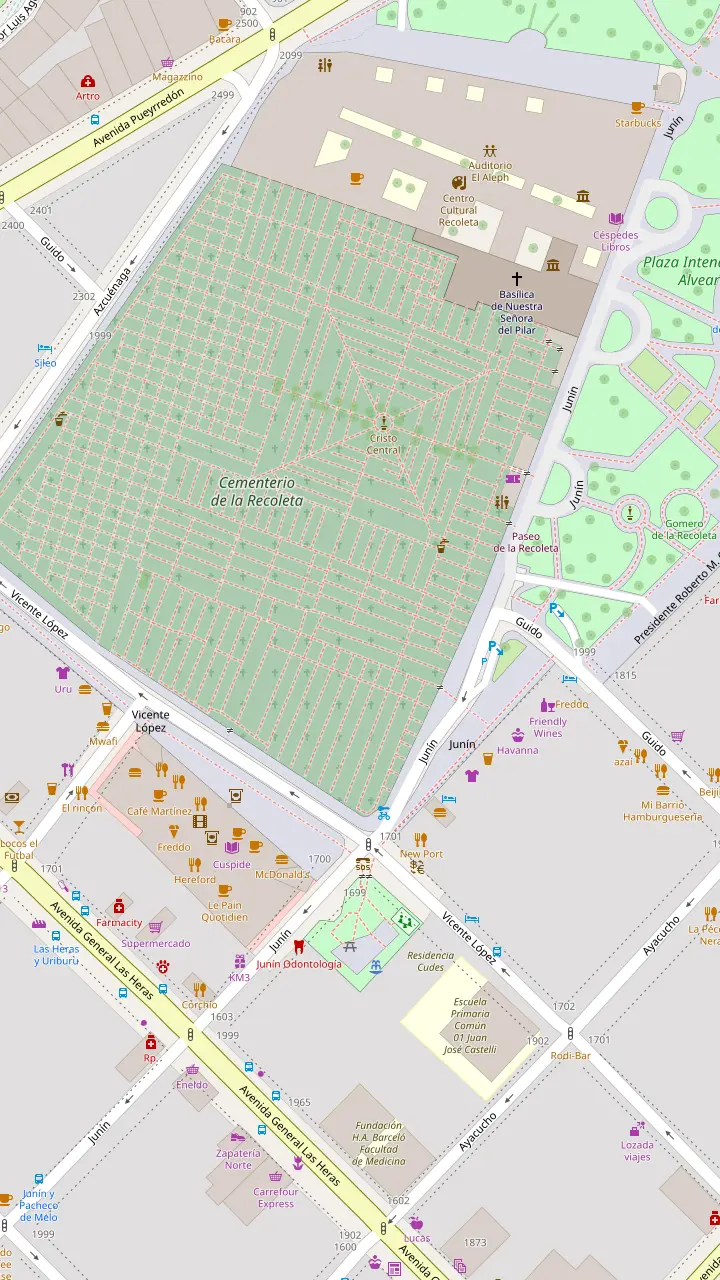
Junín 1760: the entrance for visitors, where the English tour meets by the ticket booth and free maps are handed out.
Google MapsAn Art Nouveau tomb of the early 1900s in white marble, raised by her mother.
Google MapsHer bedroom recreated inside, and a bronze of her in her wedding dress with her dog at the door.
Google MapsEduardo Rubino's tomb for the president, with figures of Liberty, Duty and Justice.
Google MapsVíctor de Pol's Masonic obelisk of 1889, crowned by a condor with open wings.
Google MapsEvita's resting place since 1976, the most visited tomb in the cemetery.
Google Maps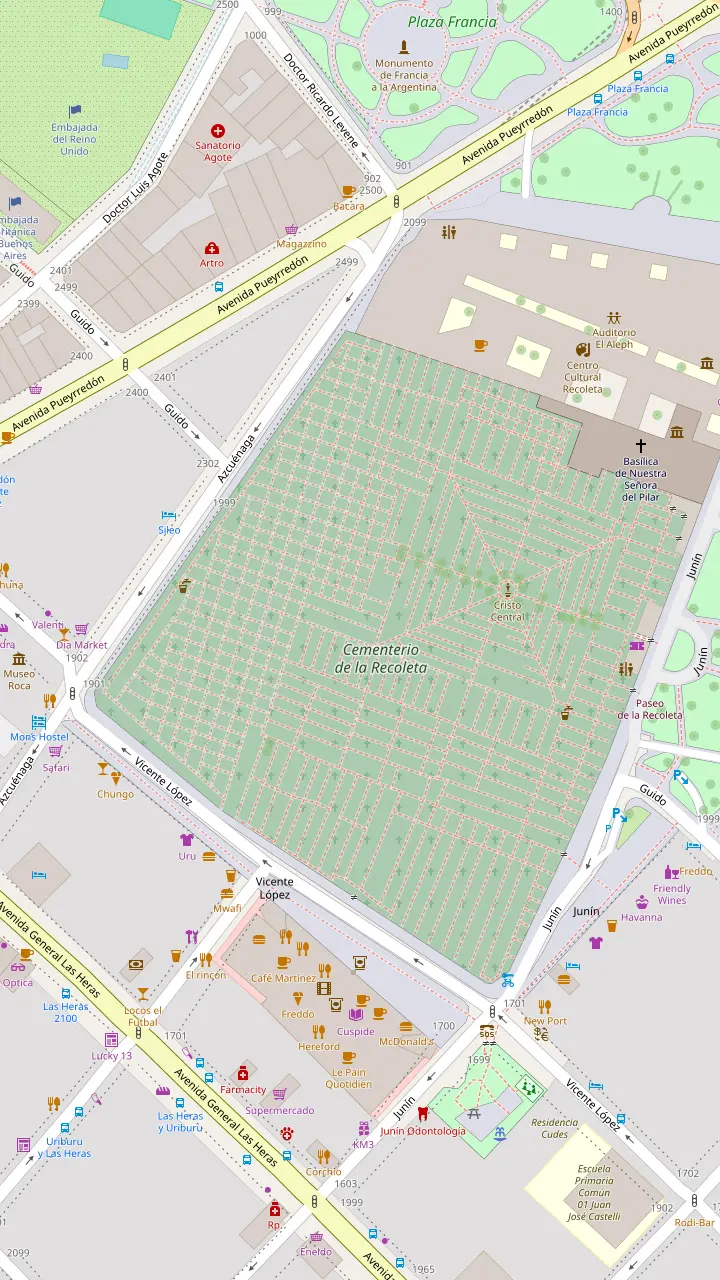
Junín 1760: the entrance for visitors, where the English tour meets by the ticket booth and free maps are handed out.
Google MapsThe bronze Christ at the crossing of the central avenues: an easy landmark to regroup at if you lose your way in the alleys.
Google MapsSimple tombs of the early republic: Cornelio de Saavedra, Antonio Sáenz and Deán Funes are honored here.
Google MapsA votive column with a naval trophy, raised by his widow Elizabeth Chitty for the Irish-born admiral.
Google MapsA compact tomb in the Egyptian mastaba manner, like that of Miguel de Azcuénaga.
Google MapsDesigned by Alejandro Christophersen; it also holds Torcuato de Alvear, the mayor who reformed the cemetery.
Google MapsThe vault of Luz María, the playwright's daughter who died in 1925 aged 15, and the source of the lady in white legend.
Google MapsThe writer's vault is among the most visited in the cemetery, the city says.
Google MapsAn Art Nouveau tomb of the early 1900s in white marble, raised by her mother.
Google MapsHer bedroom recreated inside, and a bronze of her in her wedding dress with her dog at the door.
Google MapsEduardo Rubino's tomb for the president, with figures of Liberty, Duty and Justice.
Google MapsVíctor de Pol's Masonic obelisk of 1889, crowned by a condor with open wings.
Google MapsEvita's resting place since 1976, the most visited tomb in the cemetery.
Google MapsJules Félix Coutan's sculpture of 1908: a portrait medallion and the figure of Hope.
Google MapsCrowned by a young man fighting a sphinx, carved by Léon-Ernest Drivier, a pupil of Rodin.
Google MapsThe caretaker who saved for his own tomb and statue over 30 years of work here.
Google MapsEttore Ximenes' monument to the doctor who died treating yellow fever patients in 1871.
Google MapsThe vault of the chemist who won the Nobel Prize in Chemistry 1970.
Google MapsThe family vault of the president, set where two avenues cross, with a small atrium.
Google MapsSigned by the French sculptor Mercié and raised in 1913 by the Jockey Club for its founder.
Google MapsHolds Leandro Alem, Hipólito Yrigoyen and Arturo Illia; designed by Ulrico Courtois in 1892.
Google MapsHis bust faces away from his wife's, at her own wish.
Google MapsThe tomb of the former president is among the three the tourism board names as most visited.
Google Maps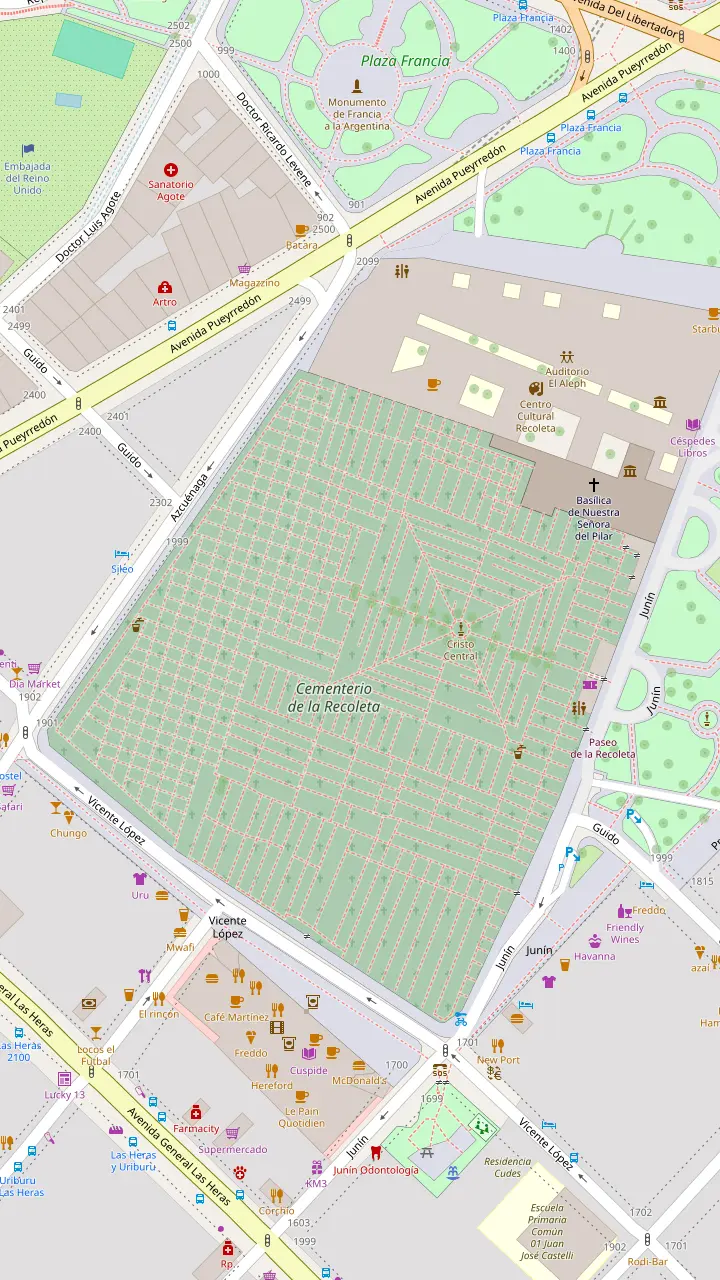
Junín 1760: the entrance for visitors, where the English tour meets by the ticket booth and free maps are handed out.
Google MapsA votive column with a naval trophy, raised by his widow Elizabeth Chitty for the Irish-born admiral.
Google MapsA compact tomb in the Egyptian mastaba manner, like that of Miguel de Azcuénaga.
Google MapsThe writer's vault is among the most visited in the cemetery, the city says.
Google MapsEduardo Rubino's tomb for the president, with figures of Liberty, Duty and Justice.
Google MapsVíctor de Pol's Masonic obelisk of 1889, crowned by a condor with open wings.
Google MapsEvita's resting place since 1976, the most visited tomb in the cemetery.
Google MapsJules Félix Coutan's sculpture of 1908: a portrait medallion and the figure of Hope.
Google MapsThe vault of the chemist who won the Nobel Prize in Chemistry 1970.
Google MapsThe family vault of the president, set where two avenues cross, with a small atrium.
Google MapsSigned by the French sculptor Mercié and raised in 1913 by the Jockey Club for its founder.
Google MapsHolds Leandro Alem, Hipólito Yrigoyen and Arturo Illia; designed by Ulrico Courtois in 1892.
Google MapsHis bust faces away from his wife's, at her own wish.
Google MapsThe tomb of the former president is among the three the tourism board names as most visited.
Google MapsThe first Argentine political and military commander of the Malvinas.
Google MapsThe founding director of a leading teacher-training school, who died in 1884.
Google MapsSarmiento's vice president, in a mausoleum of 1915 by Margarita Bonnet.
Google Maps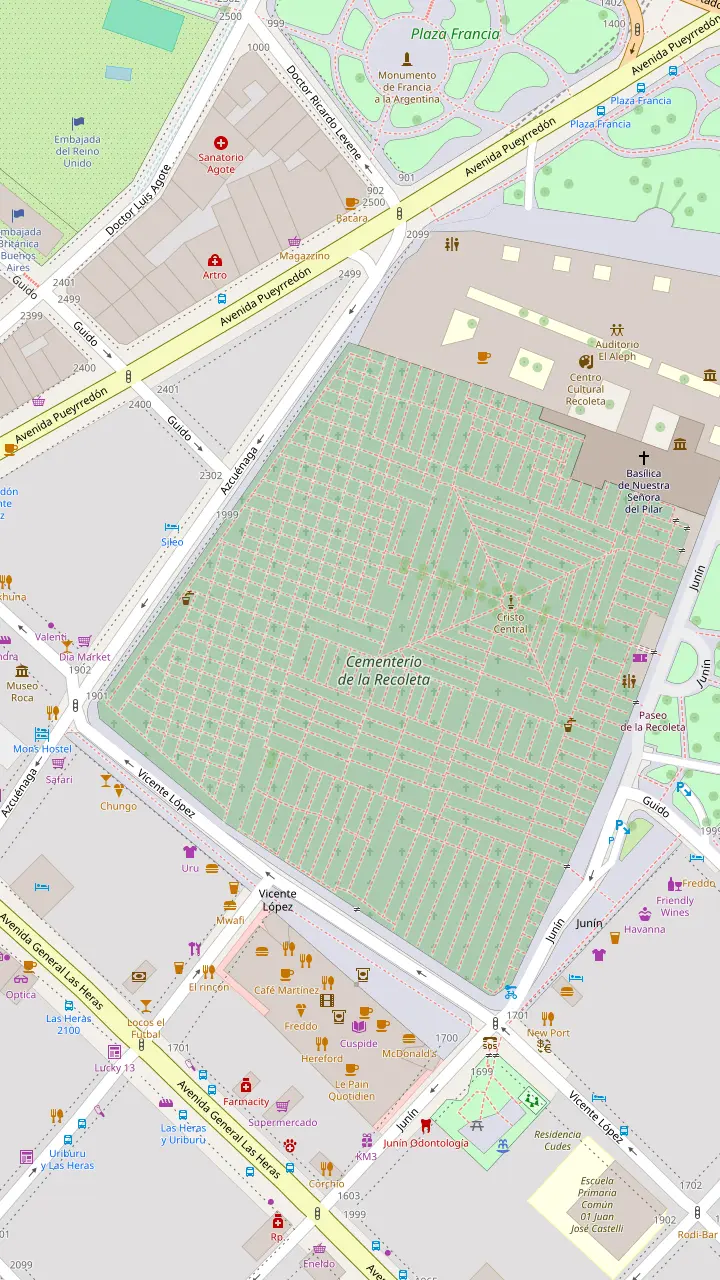
Junín 1760: the entrance for visitors, where the English tour meets by the ticket booth and free maps are handed out.
Google MapsThe vault of Luz María, the playwright's daughter who died in 1925 aged 15, and the source of the lady in white legend.
Google MapsAn Art Nouveau tomb of the early 1900s in white marble, raised by her mother.
Google MapsHer bedroom recreated inside, and a bronze of her in her wedding dress with her dog at the door.
Google MapsCrowned by a young man fighting a sphinx, carved by Léon-Ernest Drivier, a pupil of Rodin.
Google MapsThe caretaker who saved for his own tomb and statue over 30 years of work here.
Google MapsHis bust faces away from his wife's, at her own wish.
Google MapsBlack stone, huge marble angels and Masonic imagery for the family that owned La Prensa.
Google MapsA rustic grotto-tomb of about 1866, a Romantic oddity among the marble.
Google Maps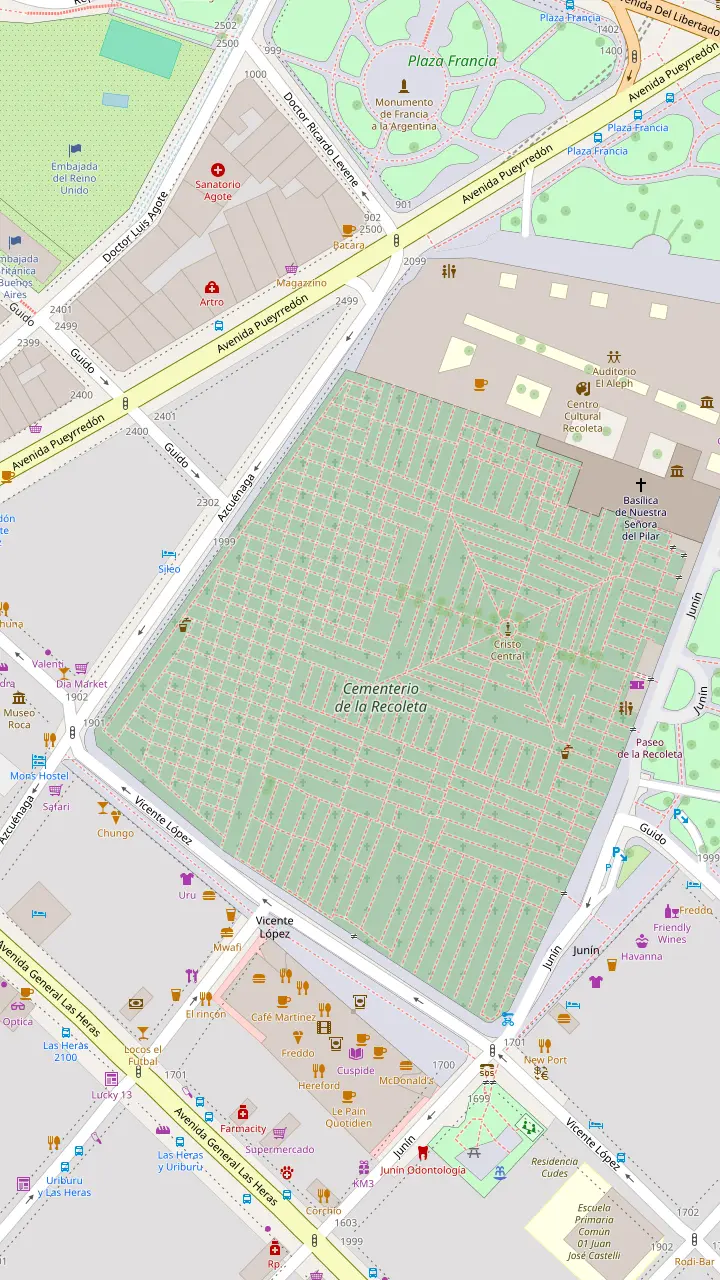
Junín 1760: the entrance for visitors, where the English tour meets by the ticket booth and free maps are handed out.
Google MapsSimple tombs of the early republic: Cornelio de Saavedra, Antonio Sáenz and Deán Funes are honored here.
Google MapsA votive column with a naval trophy, raised by his widow Elizabeth Chitty for the Irish-born admiral.
Google MapsDesigned by Alejandro Christophersen; it also holds Torcuato de Alvear, the mayor who reformed the cemetery.
Google MapsAn Art Nouveau tomb of the early 1900s in white marble, raised by her mother.
Google MapsVíctor de Pol's Masonic obelisk of 1889, crowned by a condor with open wings.
Google MapsJules Félix Coutan's sculpture of 1908: a portrait medallion and the figure of Hope.
Google MapsCrowned by a young man fighting a sphinx, carved by Léon-Ernest Drivier, a pupil of Rodin.
Google MapsEttore Ximenes' monument to the doctor who died treating yellow fever patients in 1871.
Google MapsSigned by the French sculptor Mercié and raised in 1913 by the Jockey Club for its founder.
Google MapsHolds Leandro Alem, Hipólito Yrigoyen and Arturo Illia; designed by Ulrico Courtois in 1892.
Google MapsA rustic grotto-tomb of about 1866, a Romantic oddity among the marble.
Google MapsDesigned by his son, the painter and architect Prilidiano Pueyrredon.
Google MapsSarmiento's vice president, in a mausoleum of 1915 by Margarita Bonnet.
Google Maps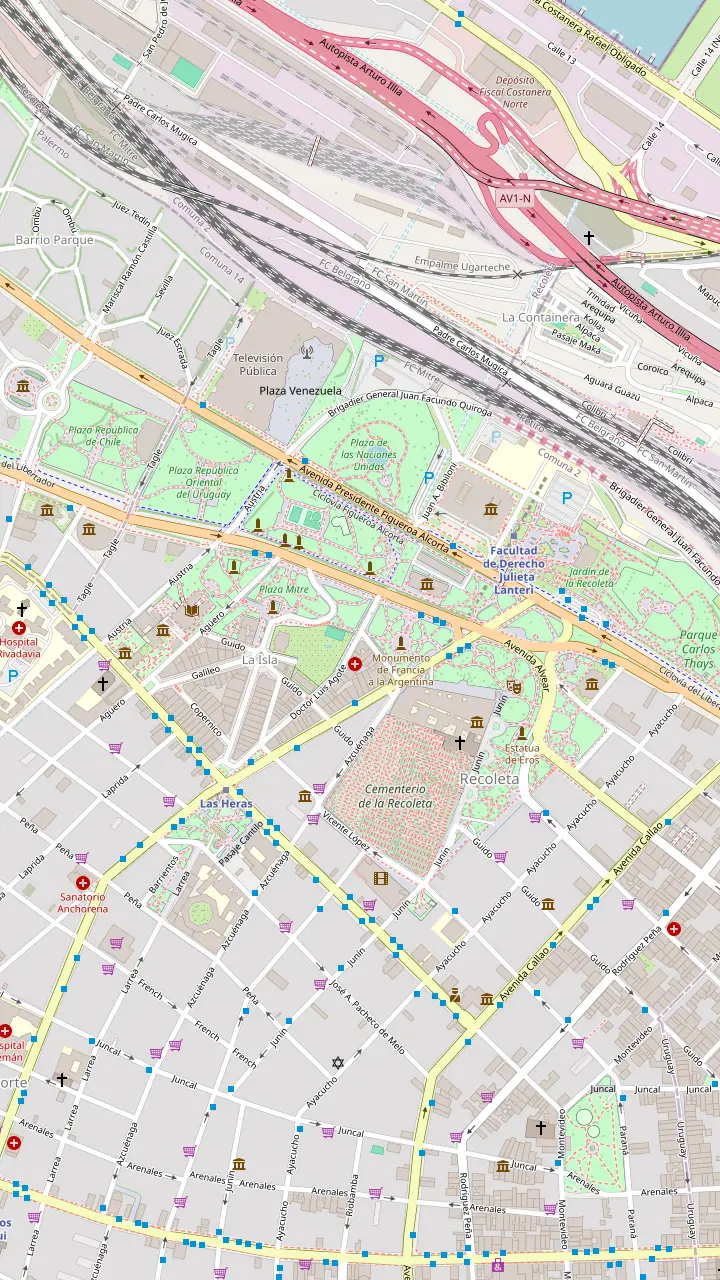
Junín 1760: the entrance for visitors, where the English tour meets by the ticket booth and free maps are handed out.
Google MapsThe white colonial church next to the gate, opened in 1732.
Google MapsThe former Recollect convent, now an arts centre with 27 exhibition rooms.
Google MapsConsidered the oldest café in the city, facing the cemetery and Plaza Francia.
Google MapsThe great gomero tree, its branches spreading 50 meters across.
Google MapsThe city's tourist assistance centre, open every day from 9 AM to 6 PM.
Google MapsThe weekend craft fair, held Saturdays, Sundays and holidays.
Google MapsNamed after the monument the French community gave for the centenary of 1910.
Google MapsHome of the largest collection of Argentine art.
Google MapsThe steel flower of 20 m whose petals open in the morning and close at midnight.
Google MapsThe University of Buenos Aires law school, a neoclassical building of 1949.
Google MapsBuilt on the site of the Perons' presidential residence, with a city view from its fifth floor.
Google MapsSubte line H, at the corner of Las Heras and Pueyrredón.
Google MapsBase map © OpenStreetMap contributors
Evita rests in her family's black granite vault, not under a national monument. Here is where it stands, how her body reached it, and how to pay your respects.
Editorial team, recoletacemeterytour.click · Updated November 9, 2026 · A 7 min read
Main facts
Eva Peron's tomb in Recoleta Cemetery is not a grand state mausoleum. She lies in the vault of the Duarte family, her own family, in one of the narrow side passages of the cemetery. No grave in the necropolis receives more visitors, according to the city's tourism board,1 and the City of Buenos Aires lists it first among the graves people come to see, ahead of the graves of a Nobel chemist and a celebrated novelist.5
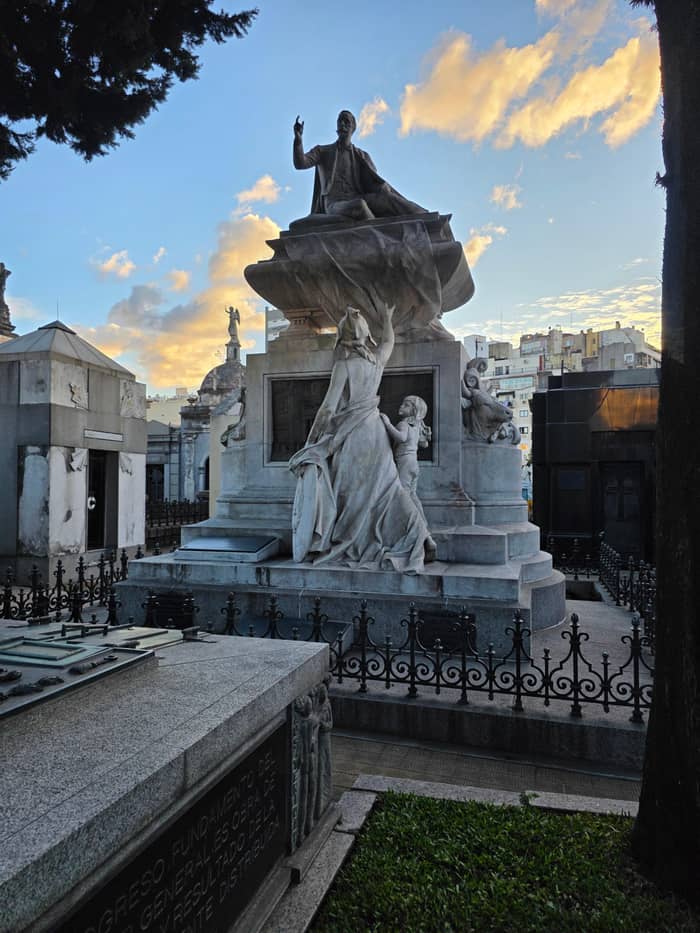
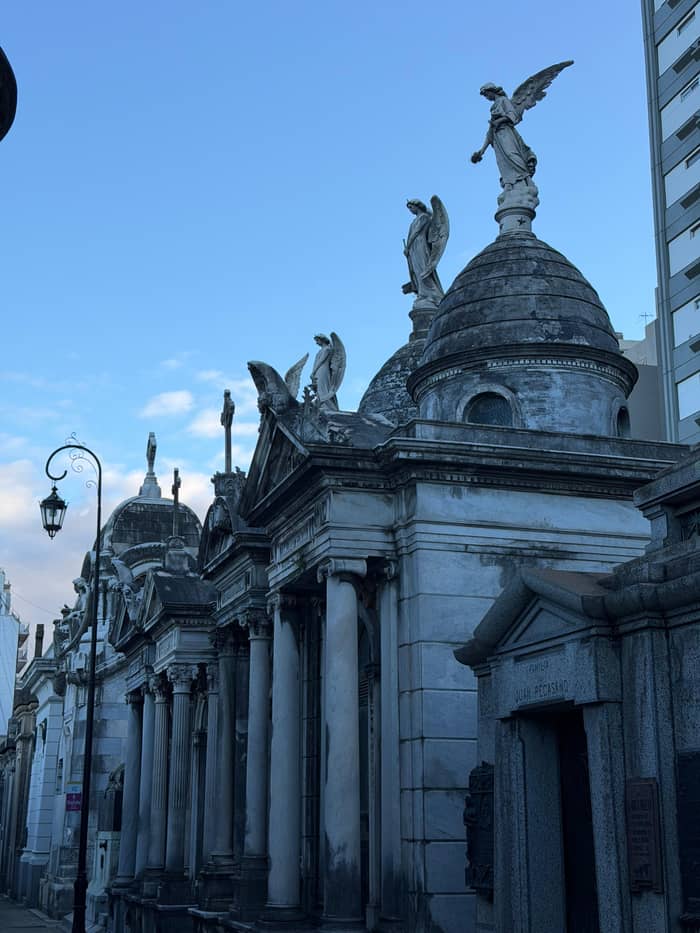
The vault itself is modest beside its neighbors: a dark facade, bronze plaques left by unions, political groups and admirers, and a narrow door. Nothing about it shouts. That restraint is part of what moves people, because the woman inside was anything but quiet in life. Many visitors stand for a minute, read the plaques, take one photograph and move on, and that rhythm is the right one to follow.
For many Argentines the tomb is a place of pilgrimage, and the tourism board says thousands of people visit it every year.6 You will meet people who come to remember a political figure and people who come out of curiosity after watching a film or a musical. Both are welcome, as long as everyone remembers that this is a family grave in a working cemetery, where burials still take place.7
Official accounts compared
| Question | Evita Museum | City and tourism board |
|---|---|---|
| Year of return | After Peron's death in 1974 | 1975 |
| Return date | 17 November | Not given |
| Depth of the crypt | Not given | 5 m or 8 m |
| Buried with Peron? | No, he went to Chacarita | Not stated |
| Most visited tomb? | Not stated | Yes |
Sources: the Evita Museum's history of her remains, the city government and its tourism board; conflicting figures appear side by side.13,4,17,18,19,1
Enter through the main gate on Junín street, at number 1760,14 and pick up the free map at the entrance, as the tourism board suggests.15 The cemetery is a grid of avenues and alleys lined with vaults, so it is easy to lose your bearings after a few turns. Keep the gate behind you as your reference point and use the map on this page, where the Duarte vault is marked with its own pin, to work out which alley to take.
The easiest clue is human. The tourism board notes that you are likely to find the Duarte mausoleum simply because of the crowd standing in front of it.2 Around midday, and whenever a guided group arrives, the passage can be full; early in the visit it is often quieter. If you see a group of people gathered in a narrow alley with phones raised, you are almost certainly there.
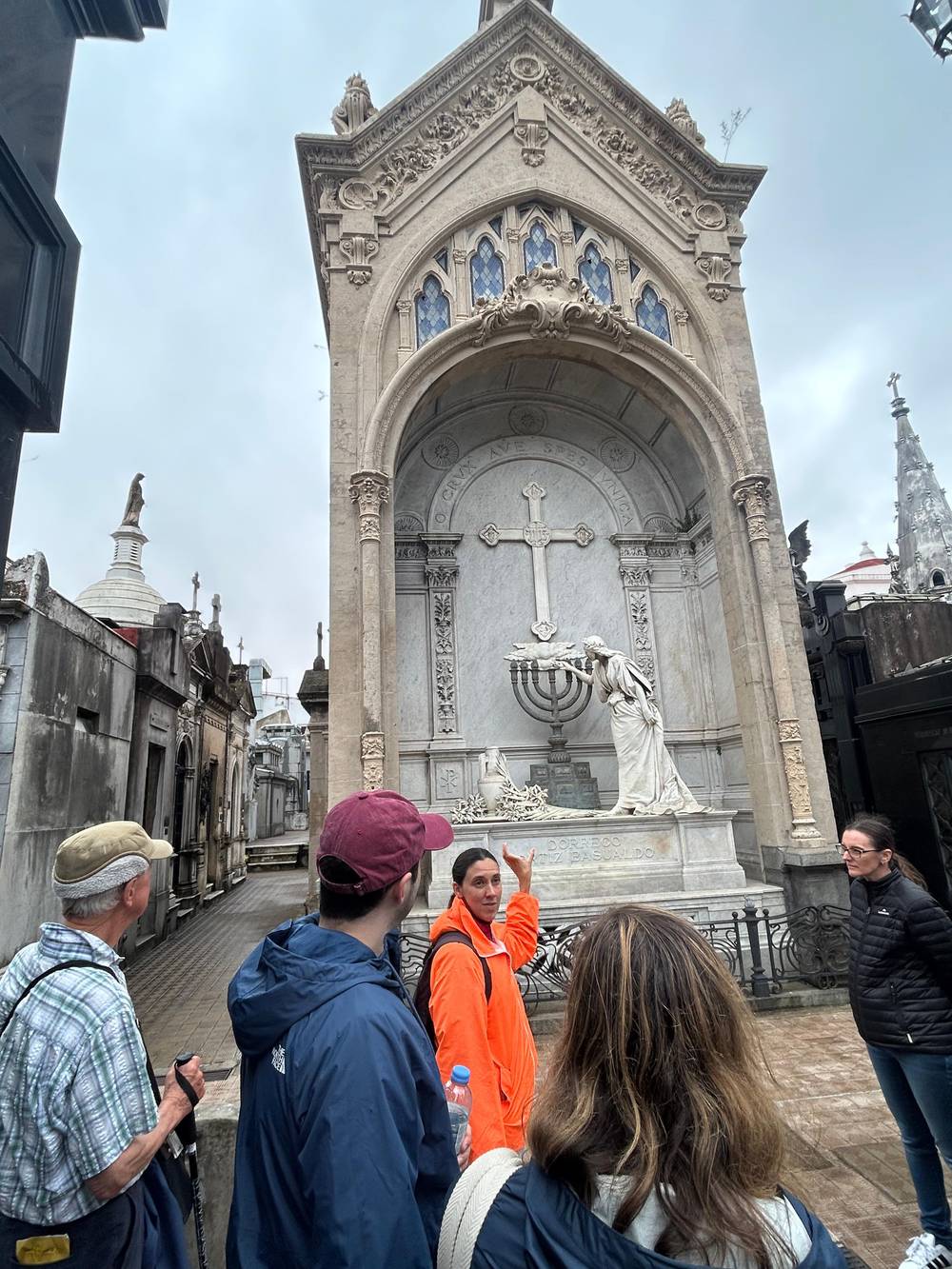
If you prefer not to search at all, join a guide. Cemetery staff lead free Spanish walks from the gate on the hour,16 and our English tour runs for 2 hours, its guide waiting beside the ticket booth. Note that this tour does not include the cemetery entrance ticket, which you buy beforehand at the gate or online.
Her body's journey
July 1952
November 1955
Army intelligence officers removed the body at night.10
April 1957
Buried in grave 41, sector 86, at Musocco.11
September 1971
Exhumed in Milan and given to Peron on 3 September.12
November
Repatriated on 17 November after Peron's death in 1974.13
After March 1976
Given to her family after the coup and buried under strict security.3,4
Eva Duarte was born in Los Toldos, in the province of Buenos Aires, on 7 May 1919.21 She moved to the capital as a teenager in 1935 and soon found work as an actress, living in boarding houses and struggling for money.22 Radio drama changed her fortunes, and in 1943 she helped found the Asociación Radial Argentina, the first union of radio workers, which she also chaired.23
At Luna Park stadium, during a fundraiser for victims of an earthquake in San Juan, she is believed to have first met the army officer Juan Domingo Peron, in 1944.24 They married in 1945.25 She never accepted a post in his government, choosing instead to work through the social foundation that carried her name,26 and in 1949 she founded the Female Peronist Party.27
Her campaigns for women's rights, from the vote for women to shared parental custody, and her welfare programs are why many people still revere her.28 Others remember her as a divisive figure, and this page takes no side. In 1951 the CGT labor confederation proposed her as candidate for vice president, a nomination she declined herself.29 She died on 26 July 1952, aged 33.8
Plan your visit
Match the visit to how much of her story you want.
If I only want to see the vault
Go alone with the map
The tomb is marked on our map, and the crowd outside it is a reliable signpost.2
If I want the whole story in English
Book the guided tour
The English tour lasts 2 hours and covers Evita's mausoleum.
If I speak Spanish and travel on a budget
Join the free city walk
Free guided walks in Spanish leave the main entrance every hour.16
If I want a small group
Pick a capped group
A capped tour takes 15 guests at most.
If I want her life, not her death
Add the Evita Museum
It opened in 2002 in a house her foundation bought.20
Evita in Recoleta
Her resting place
Inside the cemetery
Open air
By the National Library
Her life story
Lafinur street
After 16 days of public funeral, her body was taken to the CGT building to complete the embalming, which took a year.9,76 According to the tourism board, it stayed on display at her former office there.77 When the coup of 16 September 1955 overthrew Peron, the embalmed body was still on the second floor of that building.9
On the night of 23 November 1955, army intelligence officers entered the CGT and took the body away, as the Evita Museum's account records.10 For years its whereabouts were a secret kept from her family and from the public. The museum describes how candles appeared outside several of the places where it was hidden, a sign that her supporters had worked out where she was.
In April 1957 she was buried under a false name in grave 41, sector 86, of the Musocco cemetery in Milan.11 For the next 14 years a nun, known as Sister Pina, laid flowers on that grave without knowing who lay beneath them.78 The tourism board summarizes this chapter in one line: her body was taken and hidden in an Italian cemetery after the coup.79
Go with a guide
Compare guided cemetery tours that include her vault.
Weigh up 3 options
Compare guided cemetery tours that include her vault.
≈
View≈
View≈
ViewStarting prices on GetYourGuide, exchanged at the ECB reference rate. The booking page gives the exact price.
On 2 September 1971 the coffin was exhumed in Milan and driven to Madrid, where Peron was living in exile.80 The next day, 3 September 1971, Argentina's ambassador handed the body over to him, after 16 years in which its whereabouts had been unknown.12 The Evita Museum notes that it would take 3 more years for her to come home, and 2 more before she rested in Recoleta.81
Peron died on 1 July 1974, and the new president, his widow Isabel, decided to bring Eva's remains back on 17 November as a gesture of peace.13 The city government's own summary dates the repatriation to 1975,17 so the official accounts differ by a year on the date of the flight home. What they agree on is the end of the story, and the reason this page exists: her remains now rest in Recoleta, among the families who shaped the country she lived in.
Back in Argentina, her coffin was placed beside Peron's in a chapel at the Olivos presidential residence, where both stayed until the coup of March 1976.3 The military government then sent Peron's body to Chacarita cemetery and handed Eva's to her family, who buried her under strict security in the Duarte vault at Recoleta.4 That is why the couple lie apart today.
Video
Trisha Travels the World on YouTube · Playback files load only once you tap play.
After 16 years in which no one knew where she was, on 3 September 1971 Eva's body was handed over to General Peron in Spain.
Before you go
After a body stolen once, the family and the state took no chances. The tourism board describes Evita lying in a heavily fortified crypt, deep underground, built to protect her remains from another theft.18 Visitors only ever see the facade and the plaques; the coffin itself is far below the level of the alley where you stand.
The tourism board's own pages disagree on the depth. Its main Recoleta Cemetery page says some 5 meters underground,18 while its itinerary pages say she lies 8 meters beneath the marble tomb.19 We give both figures with their source rather than pick one. Either way, nothing you can see from the alley tells you how far down the coffin lies.
The security has a reason that goes beyond fear of thieves. The Evita Museum's account of the body's journey describes how, in 1955, those who held power feared that a grave could become a place of pilgrimage and a rallying point.9 Today it is exactly that, a peaceful one, and the depth simply guarantees that her family's vault stays undisturbed.
Treat the passage as a shared space. Wait your turn for a photograph, keep your voice low, and make way for anyone arriving to pray or bring flowers. Do not touch the plaques, lean on the door or block the alley for a group shot. If a guided group is talking in front of the vault, look at neighboring tombs for a few minutes and come back when the passage clears.
Evita's story continues outside the walls. Close by stands the National Library, built on the site of the Perons' presidential residence,72 and a short walk away is Plaza Evita, with a bronze statue of her by Ricardo Giannetti unveiled in December 1999.82 The square is a quiet place to sit after the crowd at the vault.
To understand her life rather than her death, visit the Evita Museum, which opened in 2002 on the 50th anniversary of her death.20 It occupies a townhouse her foundation bought in 1948 as a shelter for women arriving from the provinces.83 The tourism board's Evita itinerary takes bus 93 from Avenida Pueyrredón to Las Heras and Lafinur to reach it.75
FAQ
She lies with her own family in a side passage of the cemetery, and the vault is usually easy to spot by the people gathered in front of it.2
She was 33 years old.8
You need the cemetery admission ticket, sold by the city to residents and foreigners alike; the vault has no separate fee.84
The 2-hour guided tour sold here covers the cemetery's famous mausoleums, Evita's among them.
Sources
Visiting Recoleta Cemetery? Ask a real person here.