Free
With this map
Your own pace
- StartJunín gate
- StopsThe great tombs
- BonusGoogle Maps pins
Map your stop
Brief answer
A Recoleta Cemetery map route starts at the Junín gate and loops past the early heroes, Evita's vault, the presidents and the best-known stories before returning to the gate.
Before you start
See 41 route stops
Pick a route, then tap a marker or a stop for notes and a Google Maps link.
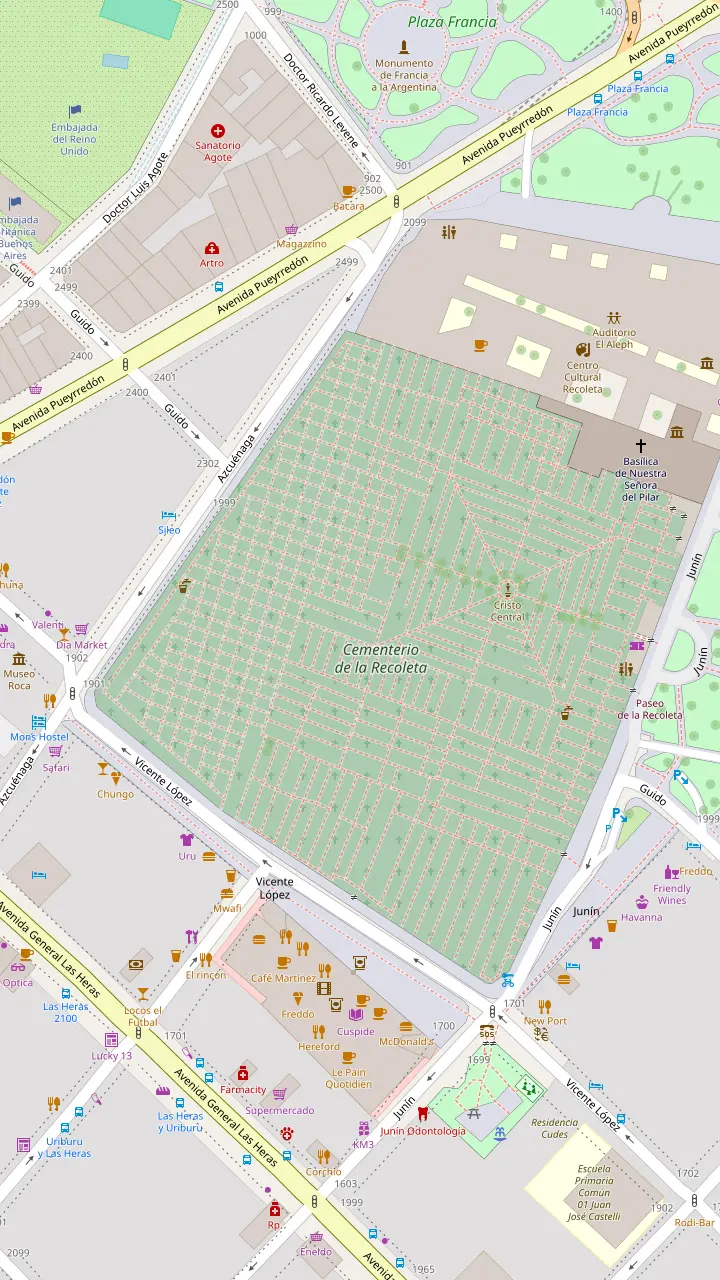
Junín 1760: the entrance for visitors, where the English tour meets by the ticket booth and free maps are handed out.
Google MapsThe bronze Christ at the crossing of the central avenues: an easy landmark to regroup at if you lose your way in the alleys.
Google MapsSimple tombs of the early republic: Cornelio de Saavedra, Antonio Sáenz and Deán Funes are honored here.
Google MapsA votive column with a naval trophy, raised by his widow Elizabeth Chitty for the Irish-born admiral.
Google MapsA compact tomb in the Egyptian mastaba manner, like that of Miguel de Azcuénaga.
Google MapsDesigned by Alejandro Christophersen; it also holds Torcuato de Alvear, the mayor who reformed the cemetery.
Google MapsThe vault of Luz María, the playwright's daughter who died in 1925 aged 15, and the source of the lady in white legend.
Google MapsThe writer's vault is among the most visited in the cemetery, the city says.
Google MapsAn Art Nouveau tomb of the early 1900s in white marble, raised by her mother.
Google MapsHer bedroom recreated inside, and a bronze of her in her wedding dress with her dog at the door.
Google MapsEduardo Rubino's tomb for the president, with figures of Liberty, Duty and Justice.
Google MapsVíctor de Pol's Masonic obelisk of 1889, crowned by a condor with open wings.
Google MapsEvita's resting place since 1976, the most visited tomb in the cemetery.
Google MapsJules Félix Coutan's sculpture of 1908: a portrait medallion and the figure of Hope.
Google MapsCrowned by a young man fighting a sphinx, carved by Léon-Ernest Drivier, a pupil of Rodin.
Google MapsThe caretaker who saved for his own tomb and statue over 30 years of work here.
Google MapsEttore Ximenes' monument to the doctor who died treating yellow fever patients in 1871.
Google MapsThe vault of the chemist who won the Nobel Prize in Chemistry 1970.
Google MapsThe family vault of the president, set where two avenues cross, with a small atrium.
Google MapsSigned by the French sculptor Mercié and raised in 1913 by the Jockey Club for its founder.
Google MapsHolds Leandro Alem, Hipólito Yrigoyen and Arturo Illia; designed by Ulrico Courtois in 1892.
Google MapsHis bust faces away from his wife's, at her own wish.
Google MapsThe tomb of the former president is among the three the tourism board names as most visited.
Google Maps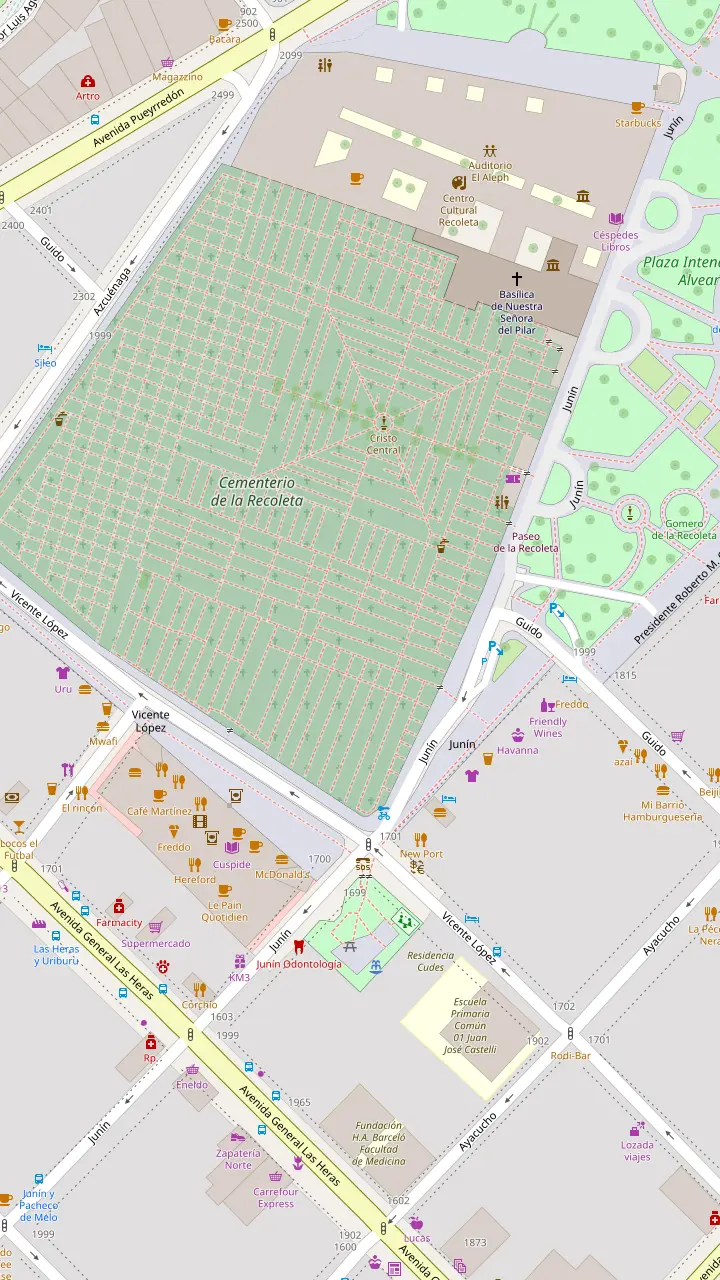
Junín 1760: the entrance for visitors, where the English tour meets by the ticket booth and free maps are handed out.
Google MapsAn Art Nouveau tomb of the early 1900s in white marble, raised by her mother.
Google MapsHer bedroom recreated inside, and a bronze of her in her wedding dress with her dog at the door.
Google MapsEduardo Rubino's tomb for the president, with figures of Liberty, Duty and Justice.
Google MapsVíctor de Pol's Masonic obelisk of 1889, crowned by a condor with open wings.
Google MapsEvita's resting place since 1976, the most visited tomb in the cemetery.
Google Maps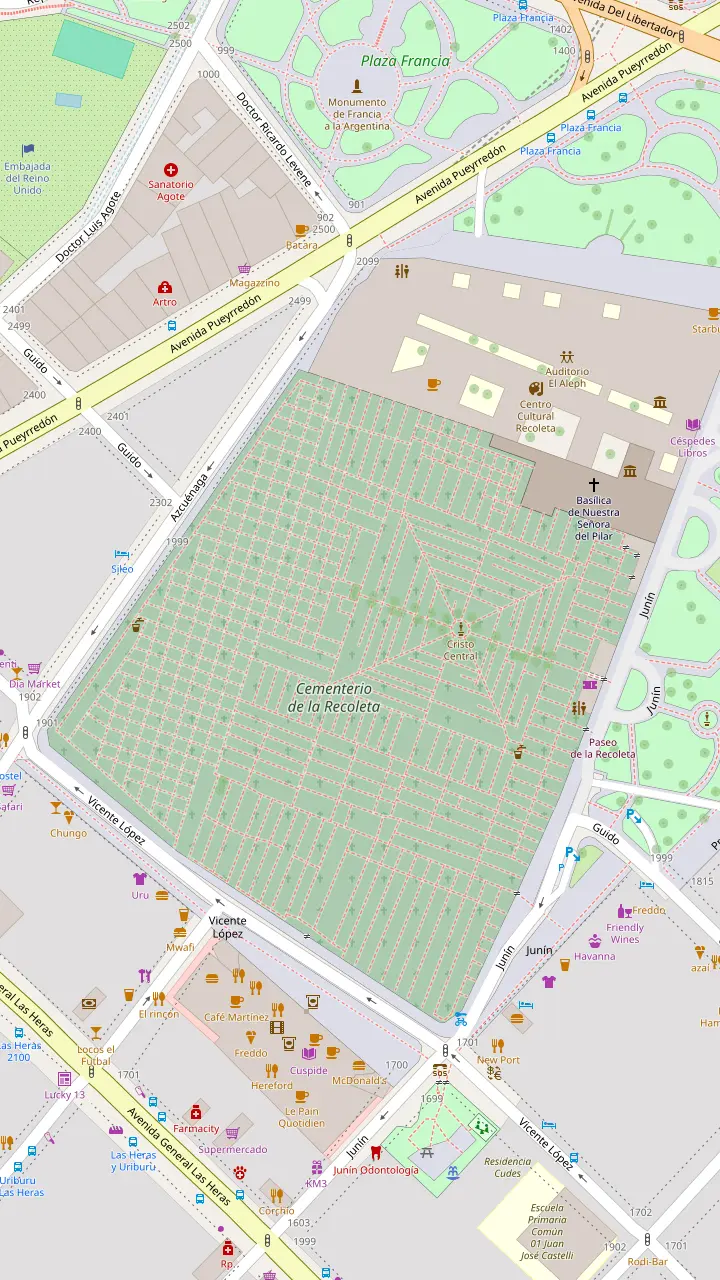
Junín 1760: the entrance for visitors, where the English tour meets by the ticket booth and free maps are handed out.
Google MapsA votive column with a naval trophy, raised by his widow Elizabeth Chitty for the Irish-born admiral.
Google MapsA compact tomb in the Egyptian mastaba manner, like that of Miguel de Azcuénaga.
Google MapsThe writer's vault is among the most visited in the cemetery, the city says.
Google MapsEduardo Rubino's tomb for the president, with figures of Liberty, Duty and Justice.
Google MapsVíctor de Pol's Masonic obelisk of 1889, crowned by a condor with open wings.
Google MapsEvita's resting place since 1976, the most visited tomb in the cemetery.
Google MapsJules Félix Coutan's sculpture of 1908: a portrait medallion and the figure of Hope.
Google MapsThe vault of the chemist who won the Nobel Prize in Chemistry 1970.
Google MapsThe family vault of the president, set where two avenues cross, with a small atrium.
Google MapsSigned by the French sculptor Mercié and raised in 1913 by the Jockey Club for its founder.
Google MapsHolds Leandro Alem, Hipólito Yrigoyen and Arturo Illia; designed by Ulrico Courtois in 1892.
Google MapsHis bust faces away from his wife's, at her own wish.
Google MapsThe tomb of the former president is among the three the tourism board names as most visited.
Google MapsThe first Argentine political and military commander of the Malvinas.
Google MapsThe founding director of a leading teacher-training school, who died in 1884.
Google MapsSarmiento's vice president, in a mausoleum of 1915 by Margarita Bonnet.
Google Maps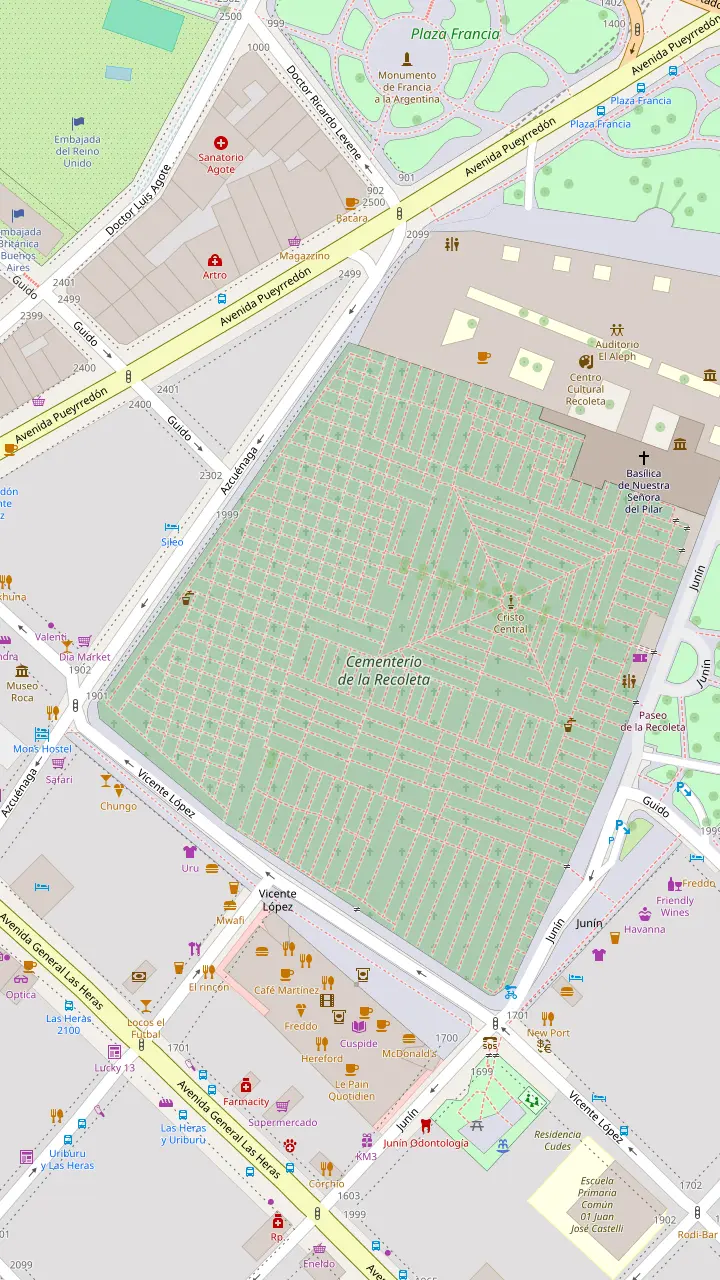
Junín 1760: the entrance for visitors, where the English tour meets by the ticket booth and free maps are handed out.
Google MapsThe vault of Luz María, the playwright's daughter who died in 1925 aged 15, and the source of the lady in white legend.
Google MapsAn Art Nouveau tomb of the early 1900s in white marble, raised by her mother.
Google MapsHer bedroom recreated inside, and a bronze of her in her wedding dress with her dog at the door.
Google MapsCrowned by a young man fighting a sphinx, carved by Léon-Ernest Drivier, a pupil of Rodin.
Google MapsThe caretaker who saved for his own tomb and statue over 30 years of work here.
Google MapsHis bust faces away from his wife's, at her own wish.
Google MapsBlack stone, huge marble angels and Masonic imagery for the family that owned La Prensa.
Google MapsA rustic grotto-tomb of about 1866, a Romantic oddity among the marble.
Google Maps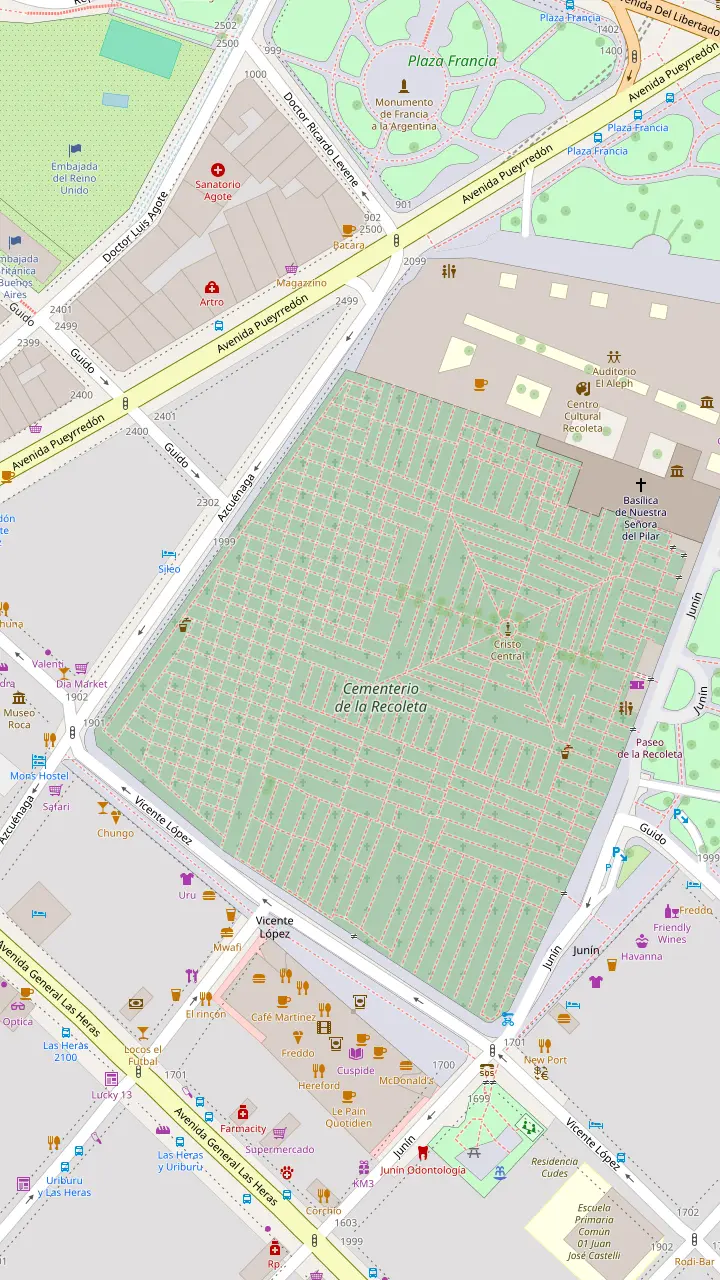
Junín 1760: the entrance for visitors, where the English tour meets by the ticket booth and free maps are handed out.
Google MapsSimple tombs of the early republic: Cornelio de Saavedra, Antonio Sáenz and Deán Funes are honored here.
Google MapsA votive column with a naval trophy, raised by his widow Elizabeth Chitty for the Irish-born admiral.
Google MapsDesigned by Alejandro Christophersen; it also holds Torcuato de Alvear, the mayor who reformed the cemetery.
Google MapsAn Art Nouveau tomb of the early 1900s in white marble, raised by her mother.
Google MapsVíctor de Pol's Masonic obelisk of 1889, crowned by a condor with open wings.
Google MapsJules Félix Coutan's sculpture of 1908: a portrait medallion and the figure of Hope.
Google MapsCrowned by a young man fighting a sphinx, carved by Léon-Ernest Drivier, a pupil of Rodin.
Google MapsEttore Ximenes' monument to the doctor who died treating yellow fever patients in 1871.
Google MapsSigned by the French sculptor Mercié and raised in 1913 by the Jockey Club for its founder.
Google MapsHolds Leandro Alem, Hipólito Yrigoyen and Arturo Illia; designed by Ulrico Courtois in 1892.
Google MapsA rustic grotto-tomb of about 1866, a Romantic oddity among the marble.
Google MapsDesigned by his son, the painter and architect Prilidiano Pueyrredon.
Google MapsSarmiento's vice president, in a mausoleum of 1915 by Margarita Bonnet.
Google Maps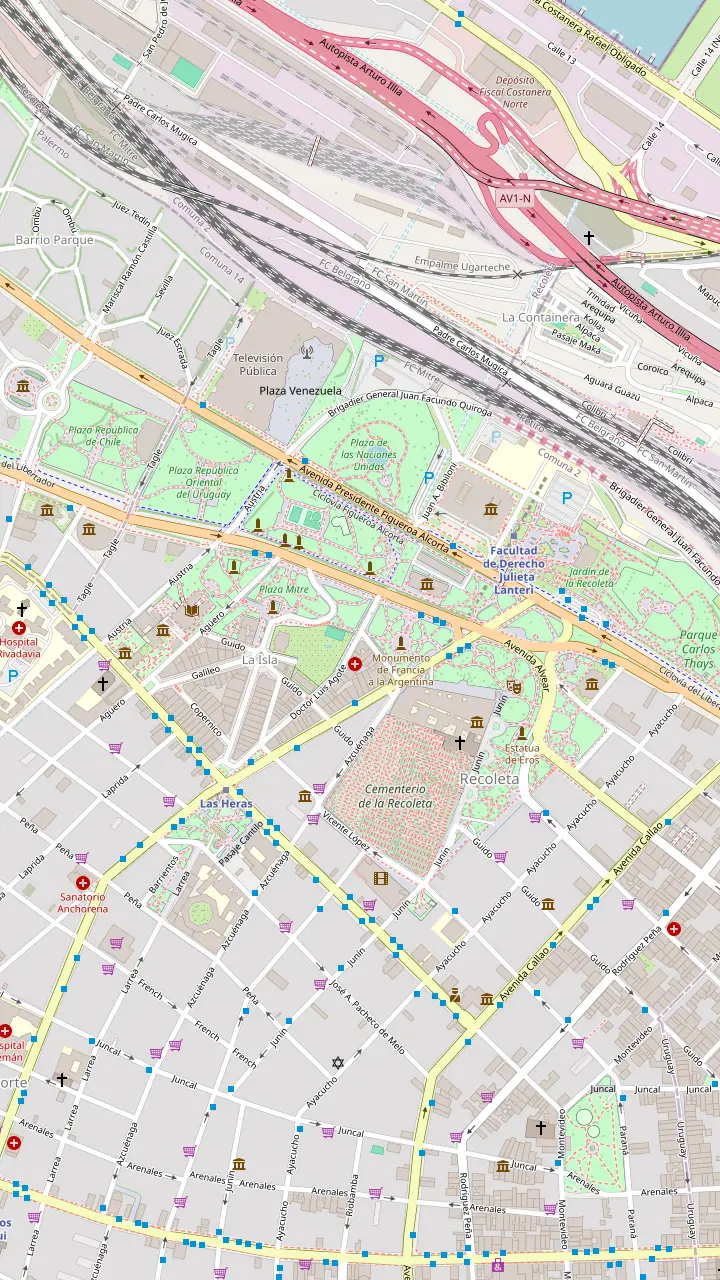
Junín 1760: the entrance for visitors, where the English tour meets by the ticket booth and free maps are handed out.
Google MapsThe white colonial church next to the gate, opened in 1732.
Google MapsThe former Recollect convent, now an arts centre with 27 exhibition rooms.
Google MapsConsidered the oldest café in the city, facing the cemetery and Plaza Francia.
Google MapsThe great gomero tree, its branches spreading 50 meters across.
Google MapsThe city's tourist assistance centre, open every day from 9 AM to 6 PM.
Google MapsThe weekend craft fair, held Saturdays, Sundays and holidays.
Google MapsNamed after the monument the French community gave for the centenary of 1910.
Google MapsHome of the largest collection of Argentine art.
Google MapsThe steel flower of 20 m whose petals open in the morning and close at midnight.
Google MapsThe University of Buenos Aires law school, a neoclassical building of 1949.
Google MapsBuilt on the site of the Perons' presidential residence, with a city view from its fifth floor.
Google MapsSubte line H, at the corner of Las Heras and Pueyrredón.
Google MapsBase map © OpenStreetMap contributors
Our Recoleta Cemetery map turns the maze of alleys into one loop from the Junín gate: early heroes, Evita's vault, the presidents and the best-known stories, stop by stop.
Editorial team, recoletacemeterytour.click · Updated November 9, 2026 · A 7 min read
This Recoleta Cemetery map makes sense once you know the plan behind it. The French engineer Próspero Catelin drew the layout in 1822, when the city opened its first public cemetery on the former orchard of the Recollect friars.5,6 Avenues and narrow alleys cross at right angles across the whole site, and the vaults line them like houses on a street.7
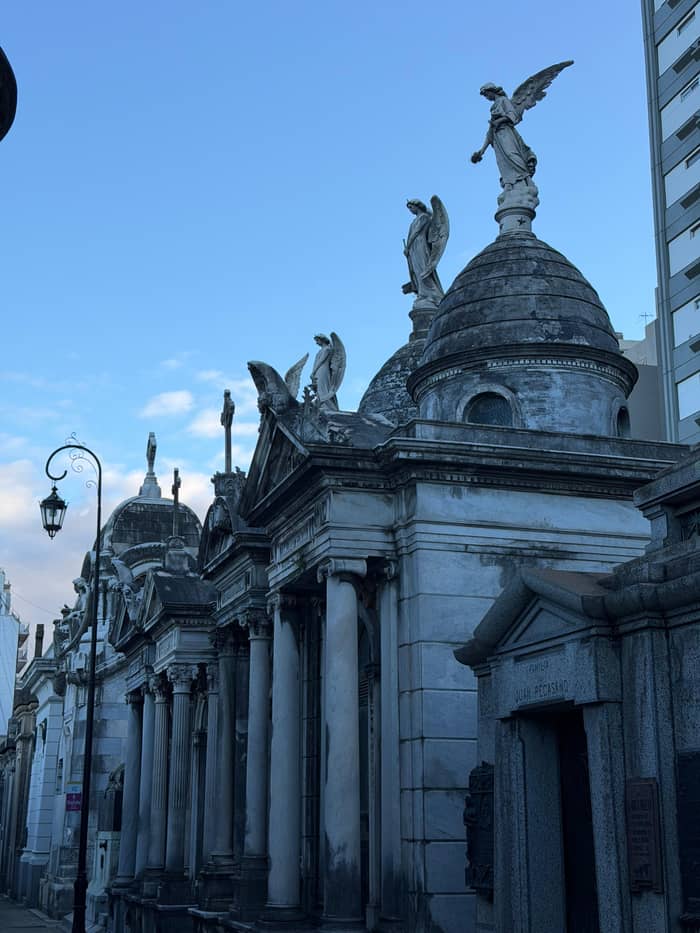
The city puts the number of vaults above 4500, built in every manner from Greek temple to Egyptian pyramid.3 Statues, sarcophagi, coffins and crypts number above 6,400 by the tourism board's reckoning,8 and describes the whole place as a labyrinthine city of the dead.9 Every alley looks like the last one after a while, which is why a plan in your hand matters more here than in most sights.
Use a pair of anchors. The gate on Junín is your way in and out, and the bronze statue of Christ where the central avenues meet is the point to return to whenever you lose your bearings. Our route starts at the gate, loops through the east side, crosses to the west and comes back past the northern wall, so you rarely walk the same alley twice and finish where you began.
What to look for
| Tomb | Look for | Style or maker |
|---|---|---|
| Guillermo Brown | Naval trophy on a column | Votive column |
| Rufina Cambaceres | Young woman at a door | Art Nouveau |
| Sarmiento | Condor with open wings | Víctor de Pol |
| Duarte vault | Bronze plaques | Evita's family vault |
| Ramón Falcón | Youth fighting a sphinx | Léon-Ernest Drivier |
| Carlos Pellegrini | Jockey Club tribute | Mercié |
| Del Carril | Busts facing apart | A couple's story |
From the national monuments commission's guide and the city tourism board.10,21,22,12,13,14,23
Pick up the free paper map at the entrance, which the tourism board recommends,2 and keep this page open on your phone, because it doubles as a map of Recoleta Cemetery: the pins match the stops described below, and each one opens in Google Maps. Tickets for local and foreign visitors are sold by the city, on the web as well as at the door,16,17 so sort yours out before you queue.
Check the visiting hours on the day. On its cemetery page the city sets visitor hours at 9 to 17 hrs daily,18 whereas the tourism board's listing reads 8am to 6pm,19 so the safest plan is to arrive in the morning and leave yourself plenty of time. The alleys have little shade, and the marble throws back the heat on a summer afternoon.
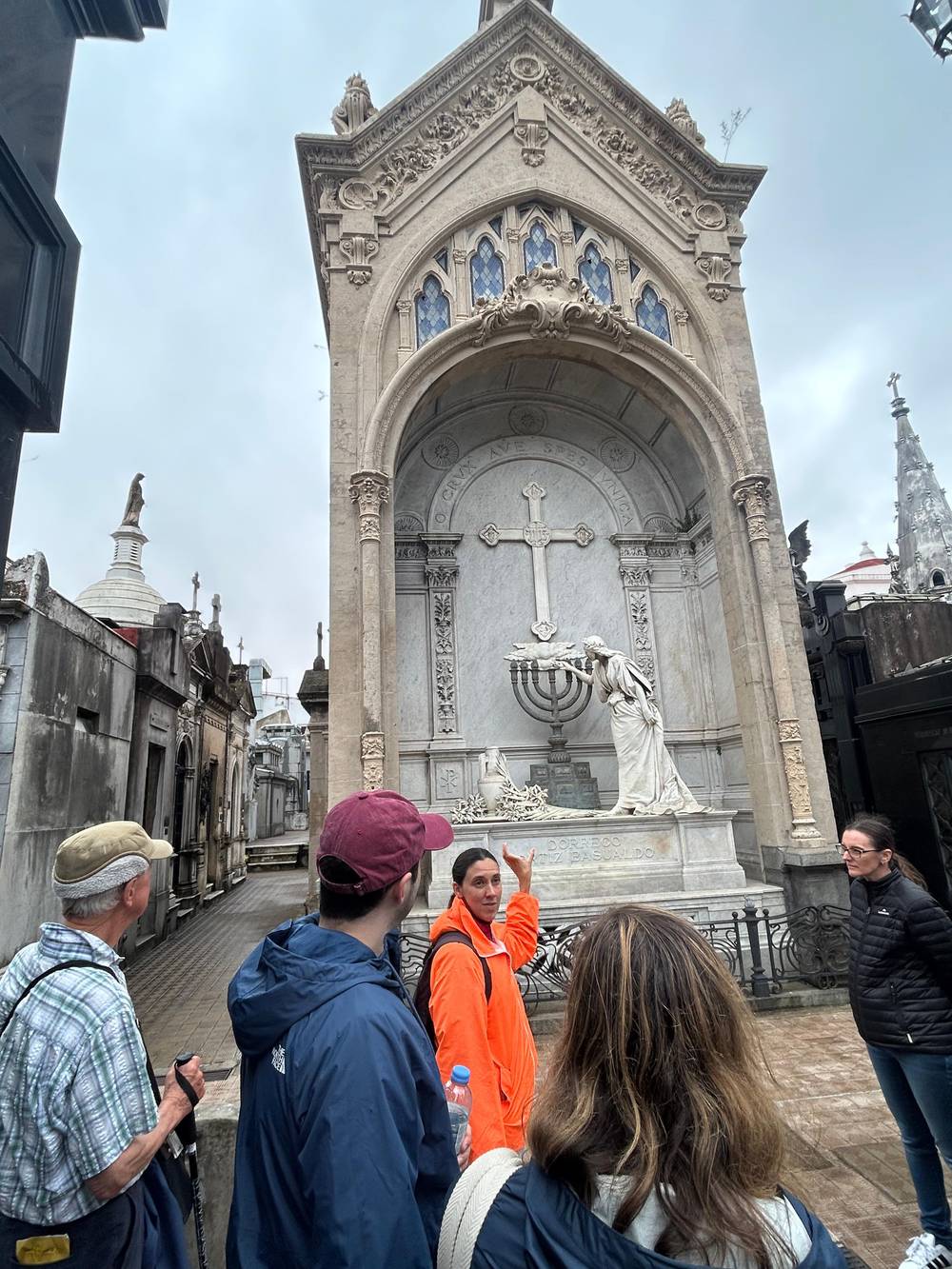
If you would rather follow a person than a map, hourly Spanish-language walks with a cemetery guide set off from the entrance at no charge.20 The English guided tour sold on this site spends 110 minutes inside and meets at the gate by the ticket booth. Many visitors do both: a guided tour first for the stories, then a second slow walk with this map to see what they missed.
The loop
First stretch
Early pantheons and Admiral Brown's naval column.10
Second stretch
Third stretch
Avellaneda, the Falcón sphinx and Alleno's statue.13
Fourth stretch
Muñiz, Leloir, Roca and Pellegrini.14
Last stretch
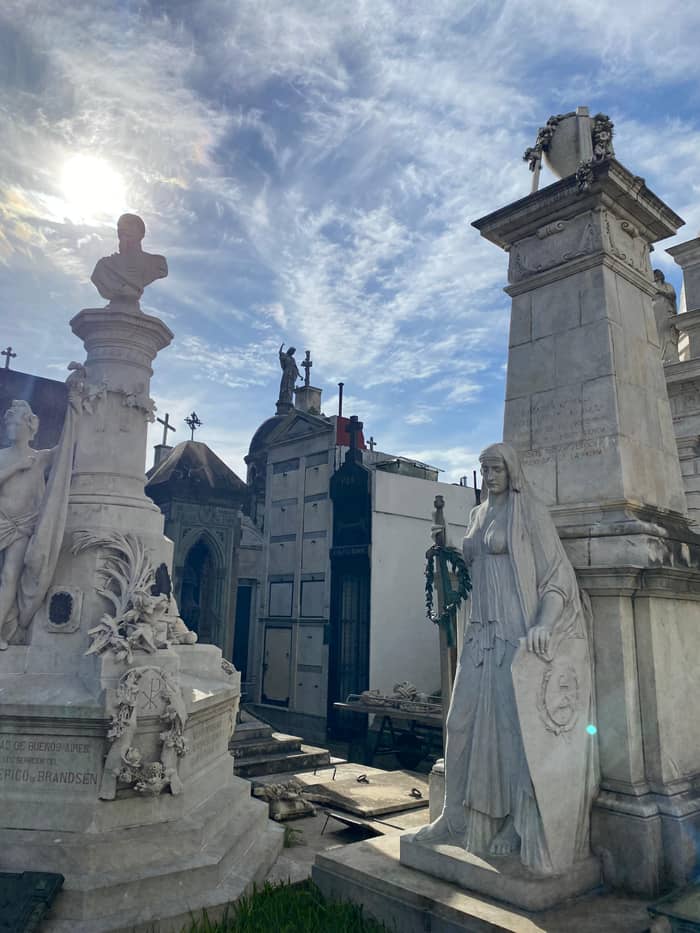
Walk in through the gate and head straight along the central avenue toward the statue of Christ. Right beside it is the pantheon of Meritorious Citizens, a group of unadorned graves for Saavedra, Sáenz, Funes and other men of the May Revolution.25 The national monuments commission describes the early pantheons, built between 1810 and 1860, as simple Neoclassical and Neo-Renaissance work, and here you can see what it means.26
Next comes Admiral Brown, born in Ireland, who commanded the patriot navy through much of the War of Independence.27 Elizabeth Chitty, his widow, gave him a column topped with a naval trophy, its reliefs recalling his battles at sea.10 Nearby, the tomb of Manuel Dorrego takes the compact shape of an Egyptian mastaba, a fashion that followed Napoleon's expedition to Egypt.28
Bear toward the eastern wall for the Alvear vault by Alejandro Christophersen, resting place of the general Carlos María de Alvear and of Torcuato, the mayor behind the cemetery's great reform.29 Beside it rests Luz María García Velloso, the girl at the heart of the lady in white legend.30 Then walk south to the vault of the writer Adolfo Bioy Casares, one of the most visited in the cemetery.31
Map or guide?
Decide by what you want to bring home.
If I want photos at my own pace
Walk alone with this map
Every stop on the route is marked, with a Google Maps link per pin.
If I want the stories behind the stone
Book the English tour
It spends 110 minutes inside with a guide.
If I am on a budget and speak Spanish
Join the free hourly walk
Free guided walks leave the main entrance every hour.20
If I only care about Evita
Head straight for the Duarte vault
No tomb here draws more visitors.12
If I love sculpture
Follow the architecture tab
Over 90 vaults are National Historic Monuments.24
Ways in
Free
Your own pace
Free
In Spanish
Guided
Sold on this site
Deeper in the southern alleys stands Rufina Cambaceres, carved in white marble on a tomb of the early 1900s.21 Our stories page tells why her mother commissioned it.33 A short walk on, the vault of Liliana Crociati shows a bronze of her in her wedding dress with her dog, and her bedroom recreated inside.11
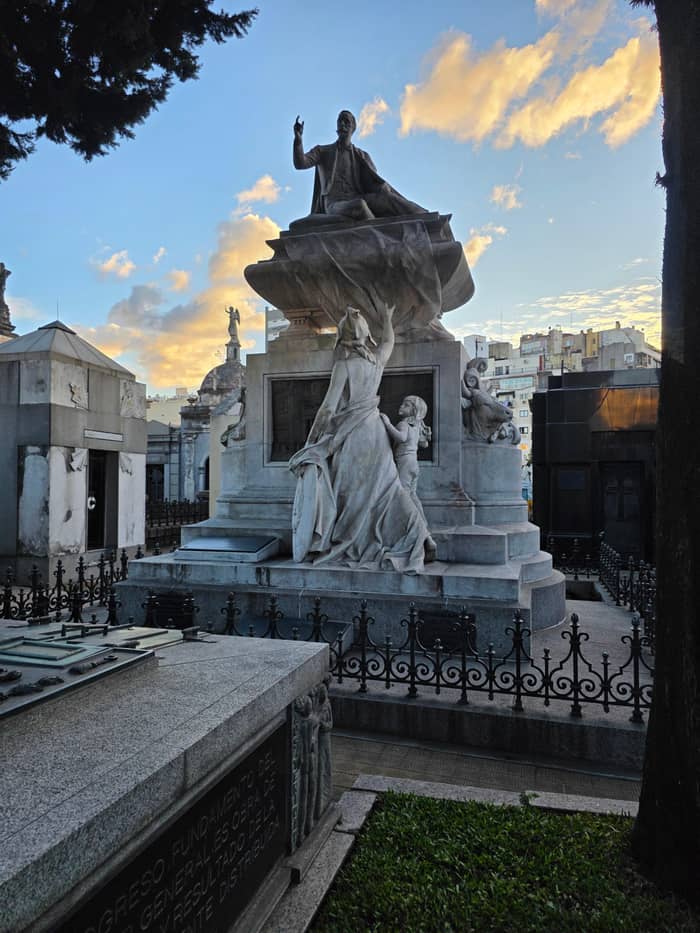
Nearby, President Mitre lies beneath Eduardo Rubino's allegories of Liberty, Duty and Justice, marble virtues guarding his name.34 Then comes Domingo Faustino Sarmiento, whose Masonic obelisk by Víctor de Pol, made in 1889, is crowned by a condor with spread wings.22 The tourism board names it among the most visited tombs in the cemetery, and on a busy morning you will rarely have it to yourself.4
From Sarmiento, a few turns to the west bring you to the Duarte family vault, where Eva Peron lies.12 The tourism board points out that the crowd outside usually gives it away.67 Wait your turn quietly, read the plaques, and move on to let others in; our page on Evita's tomb tells the long story of how she came to rest here.
Prefer a guide?
Compare guided versions of this route.
Weigh up 3 options
Compare guided versions of this route.
≈
View≈
View≈
ViewStarting prices on GetYourGuide, exchanged at the ECB reference rate. The booking page gives the exact price.
Cross west to the far wall for Avellaneda, whose 1908 monument by Coutan pairs his portrait with a languid Hope.37 In the corner beyond rises the mausoleum of Ramón Falcón, crowned by a young man wrestling a sphinx, the work of Léon-Ernest Drivier, a pupil of Rodin.13 It is hard to walk past without stopping.
Turn north to find the tomb of David Alleno, who worked for 30 years as a gravedigger here and saved for his own plot and a statue of himself.38 Just beyond stands the monument to Francisco Muñiz, the physician who died treating yellow fever patients in 1871, commissioned from the sculptor Ettore Ximenes.39 The commission calls him the first Argentine naturalist.68
Back toward the center, look for the chemist Leloir, Nobel laureate of 1970, whose plain family vault draws a steady stream of visitors, the city says.40,31 Close by, look for Roca's family vault, which the commission describes as standing on a crossing of avenues behind a small atrium.41 Then look for Carlos Pellegrini's mausoleum, signed by the French sculptor Mercié and raised in 1913 by the Jockey Club.14
Video
Narrated Travel Adventures by Berra on YouTube · Playback files load only once you tap play.
Lose yourself for hours in this labyrinthine city of the dead.
Ready to walk
Make for the northern wall, where the monument to the 1890 revolutionaries shelters Alem, Yrigoyen and Illia.15 The French architect Ulrico Courtois designed it in 1892, with bronzes by Emilio Cantillón.42 Presidents and party founders sharing one monument make it a quiet place of political pilgrimage, so walk past it softly and read the names.
A few alleys along you find Salvador María del Carril, the country's first vice president. Look up at the busts: his and his wife's are turned in opposite directions, by her own instruction, the tourism board relates.23 It is the most human of the cemetery's stories, told in stone with no words at all, and easy to miss unless you look up at the figures.
Finish at the tomb of Raúl Alfonsín, another of the tombs the tourism board names as the most visited,4 then follow the central avenue back to the Junín gate. Outside the gate, the whitewashed Pilar church, opened in 1732, is the neighbor that gave this corner its colonial look.49 A café terrace across the square is the natural place to sit down and look at your photos.
People often search for a Recoleta Cemetery map PDF to print at the hotel. The easiest official version is the sheet you collect as you go in.2 For the streets around it, the city offers a guide to download plus recorded commentary for every stop on its Recoleta circuit, which starts at the cemetery and the basilica.66,69 Download them before you go, because signal can be weak among the vaults.
This page works as a printable guide too: every tab above is a separate walk through the same grid, and each pin opens its position in Google Maps. Save the page or take screenshots of the panels before you enter. Our route follows the grid rather than straight lines, so expect to double back a little in the southern alleys, where the vaults stand closest together.
However you navigate, the cemetery rewards slowness. Look at doors, keys, wreaths and the small chapels behind the glass; read the names of sculptors cut into the stone. National protection covers over 90 vaults,24 yet plenty of fine ones carry no special status at all. Let the route guide you, and leave room to wander into the alleys that catch your eye.
FAQ
The tourism board advises picking up the map at the entrance before you start.2
Junín 1760 is the visitors' entrance and the meeting point for the English tour.1
The tourism board names these as the most visited tombs.4
The English guided tour spends 110 minutes inside; walking alone, add time for getting lost.
Recorded commentary for each stop of the Recoleta circuit can be downloaded from the city.66
Free guided walks leave the main entrance every hour.20
Sources
Visiting Recoleta Cemetery? Ask a real person here.