Big names
History seekers
Presidents and founders
- SeeMost visited tombs
- Best withA guide
- TimeAbout 2 hours
Tap-to-check list
Things to do · 9 items
Tick off each point as you complete it. This device keeps your progress.
All ticked. Only the day and the number of visitors are left to choose.
Get a seatYes, for most travellers, as long as you treat it as what it is: a working place of burial that is also a vast open-air gallery of sculpture in the heart of Buenos Aires.
Editorial team, recoletacemeterytour.click · Updated November 9, 2026 · A 7 min read
Main facts
Is Recoleta Cemetery worth it? On the evidence, yes. It was the first public cemetery of Buenos Aires, built in 1822 to a plan by the French engineer Prospero Catelin, and more than 90 of its vaults have been declared National Historic Monuments.7,1 It packs a remarkable amount of Argentine history into a walk you can finish in a morning.
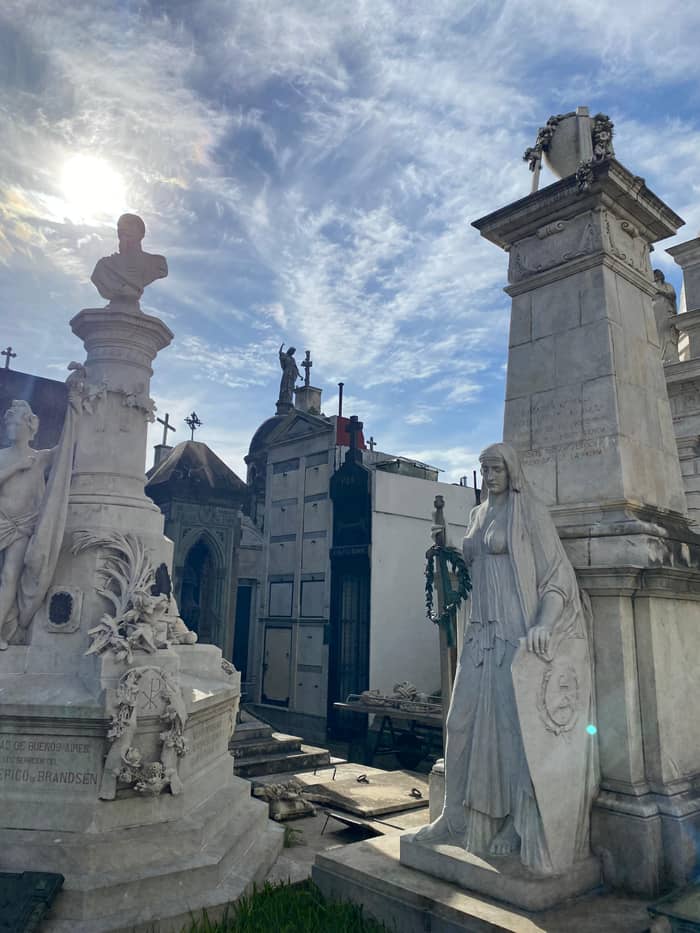
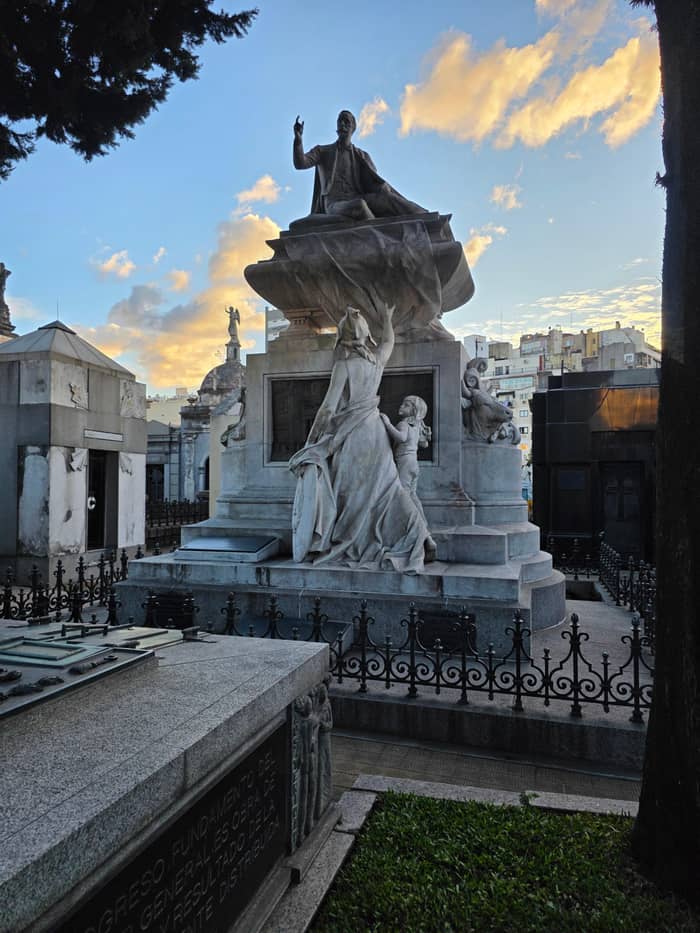
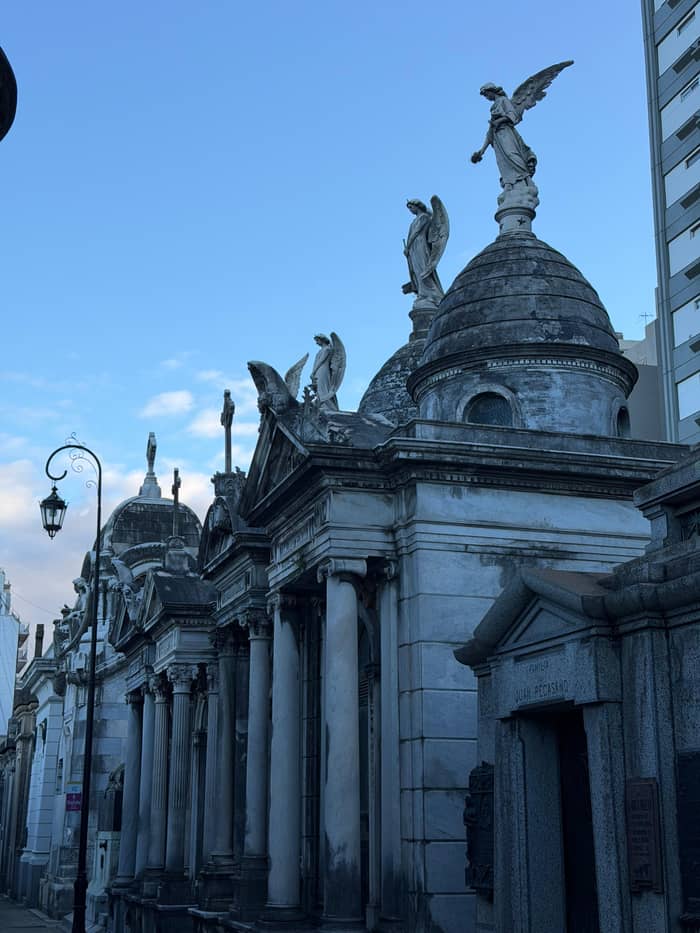
The scale surprises people who expect a churchyard. The city counts more than 4,500 vaults in very varied styles, from Greek temples to Egyptian pyramids, and the tourism board counts over 6,400 statues, sarcophagi, coffins and crypts.2,8 Walking its avenues feels like moving through a small city of marble, with streets, squares and corners of its own.
It is also where Argentina keeps many of its famous dead. The city names more than 200 figures of Argentine history buried there, among them Eva Duarte de Peron, Raul Alfonsin and Luis Federico Leloir.9 Even visitors with no interest in cemeteries tend to leave with a clearer picture of the country than a museum would give them in the same time.
Do and avoid
| Situation | Do | Avoid |
|---|---|---|
| A family at a vault | Move on quietly | Photographing them |
| Glass vault doors | Look from the path | Touching or knocking |
| Audio commentary | Use earbuds | Playing it aloud |
| Steps and railings | Stay on the paving | Climbing for angles |
| Flowers and offerings | Leave them be | Moving or taking them |
| A tripod or drone | Ask the office first | Setting up unasked |
Our own advice for a working cemetery; the office serves the public every day from 8 to 14 hrs.16
Honesty helps here. If you dislike crowds, the most visited graves can feel busy, especially that of Eva Peron, which the city lists among the most visited tombs alongside those of Leloir and Bioy Casares.15 Arriving early in the tourist window, which opens at 9 hrs, is the simplest remedy.13 By the time the first guided groups gather at the busiest vaults, you will already have seen them in peace and moved on to quieter avenues.
Visitors who are grieving a recent loss may find the place harder than expected, and some children are unsettled by the idea of coffins visible behind glass doors. Neither is a reason to stay away, but it is worth knowing in advance. A short, planned visit to a few vaults is gentler than a long wander.
Finally, if you have only a few hours in Buenos Aires and no interest in history, art or architecture, the cemetery may not be your priority. For everyone else it rewards even a short visit, and the English tour sold here keeps that visit to 2 hours, from $12. Since calling it off a day early is free, holding a place costs you nothing if plans shift.
Is Recoleta Cemetery safe? The cemetery itself is a calm, enclosed space with published hours, and the streets around it are known for their grand mansions, such as those along Avenida Alvear.6,19 The UK government's travel advice lists places in Buenos Aires for particular caution, such as Palermo, San Telmo, La Boca, Retiro and Florida Street; Recoleta is not named on that list.17
That does not mean you can relax completely. That advice also names buses, trains and their terminals as the places pickpockets work, so the ride to Recoleta is where your bag should stay closest.4 It also warns that thieves can snatch a phone while you are using it on the street.5 Step into a doorway or a cafe to check a map, rather than standing at the kerb with your phone out.
Inside the walls, the main risks are practical ones: uneven paving, heat on summer afternoons and losing your way among the avenues, which all look alike after a while. Take a map at the gate, keep water with you, and fix a spot to regroup if your party drifts apart.12 At closing, leave with other visitors rather than lingering in a far corner on your own.
Quick check
Find your situation and the advice that goes with it.
If I love history and architecture
Go, and take a guide
More than 90 vaults are National Historic Monuments.1
If I worry about safety
Go, with normal care
UK advice does not list Recoleta among its caution areas.17
If I want great photos
Go early or late
Tourist visits run from 9 to 17 hrs; respect mourners.13
If I travel with a wheelchair
Plan a shorter route
The English tour is listed as wheelchair accessible.
If I visit in high summer
Start at opening
January averages a daily high of 29.6 °C.18
Visitor types
Big names
Presidents and founders
Open-air gallery
Marble and bronze
Quick visit
One focused hour
Can you take pictures in Recoleta Cemetery? The city's cemetery pages publish visiting hours and ticket rules, but no ban on personal photos of the architecture and sculpture. The tourism board itself praises its eerie beauty and its mix of Art Nouveau, Art Deco, baroque and Gothic revival vaults, which is exactly what most cameras are drawn to.20
What matters is how you photograph. The gates are open for general visits from 7 to 18 hrs, so a mourner can be beside you at any hour.6 Never photograph people at a vault, a funeral or a prayer without asking, and if a family is present, move on and come back later for your picture of that door.
Keep the camera to yourself in other ways too. Do not climb steps, railings or plinths for an angle, do not lean on vault doors, and leave flowers and offerings exactly as they are. For tripods, drones or any commercial shoot, ask the cemetery office first; it serves the public from 8 to 14 hrs every day.16
A respectful visit
Recoleta is not a museum that once held burials; it is a cemetery in use. The city's office for the cemetery serves the public every day, and families still own and visit their vaults.16 Many vault doors are glass or open grillwork, so you will see coffins, flowers and photographs inside. Look, but do not reach in, knock or try handles. Some vaults are well kept and some are crumbling, but every one of them belongs to a family.
Speak quietly, especially near people who are clearly visiting their own dead. Keep audio guides to earbuds and phone calls short. A group should pause on the wider avenues rather than blocking a narrow passage in front of a family vault, and a good guide sets that example without being asked. If you are walking alone, follow the same habit and let the family finish before you step closer.
Dress needs no special rules, but comfortable, modest clothing suits the setting and the walking. In summer, what matters more than any outfit is sun protection and shoes that grip, because much of a visit is spent on stone paving in the open. A light scarf or shawl is handy if you plan to step into the basilica next door afterwards.
Video
FRANKO TRAVELS on YouTube · Playback files load only once you tap play.
Thieves and pickpockets operate on public transport and at bus and train terminals.
The cemetery has little open shade on its main avenues, so plan for sun. Afternoon highs average 29.6 °C in January and 15.1 °C in July at the observatory station.18,18 A hat, sunscreen and water are the basic kit from late spring to early autumn. Narrow passages between tall vaults give the only reliable shade, so plan rests there rather than on the wide avenues.
The Recoleta tourist assistance centre on Avenida Quintana is a useful stop before you go in. It is open every day from 9am to 6pm and offers Wi-Fi, phone charging and water refills.21,11 Cafes around Plaza Francia, including La Biela, which the tourism board considers the oldest cafe in the city, are good places for a rest afterwards.22 Its outdoor tables look over the square, the cemetery and the Pilar church, a calm view after a long walk among the vaults.23
For visitors with reduced mobility, the English tour sold here is listed as wheelchair accessible. Inside, expect long distances on paving that is uneven in places, and narrow passages between vaults. A shorter route along the main avenues, planned with the entrance map, makes the visit easier.12 Visit in the cooler morning hours, and ask the guide at the start to keep to the smoother avenues where possible.
If time is tight, decide in advance what you most want to see. The tourism board names the tombs of Eva Peron and of former presidents Sarmiento and Raul Alfonsin as the most visited, which makes a sensible core for a first visit.24 Add a few vaults chosen for their architecture and you have a focused hour. Mark them on the map before you go in, since searching for a single vault among thousands is what eats most of a short visit.
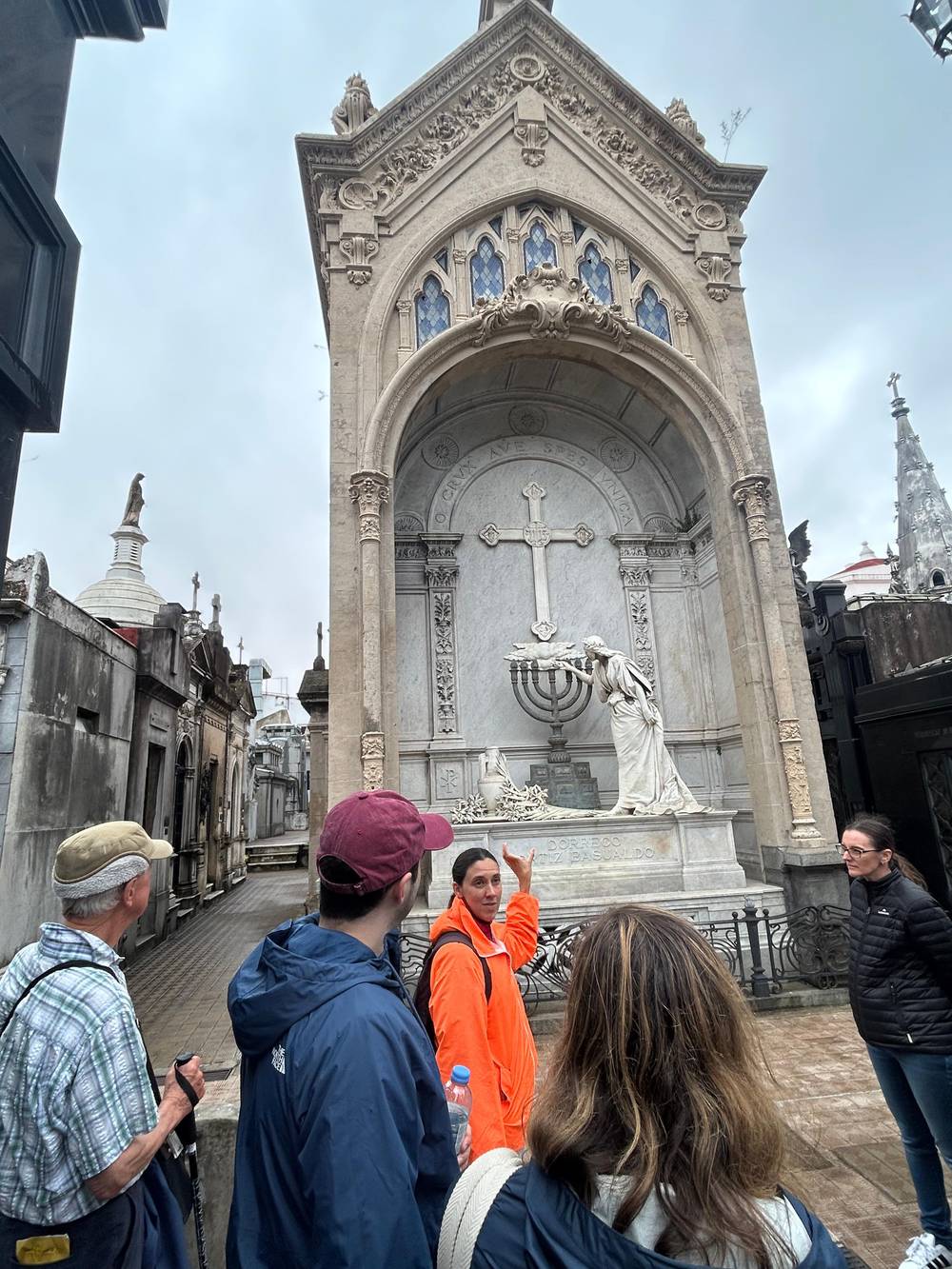
A guide is the quickest way to turn that hour into understanding, and it saves the searching altogether. The English tour meets at the gate at Junin 1760, where the guide waits beside the ticket booth, and spends 110 minutes inside. Buy your entry before the meeting time so the group can start together.10
Afterwards, step next door. The Basilica del Pilar, opened in 1732, keeps a baroque main altarpiece with silverwork from Peru, and the Recoleta Cultural Centre fills the old convent of the Recollect friars with exhibitions.14,25,26 Both make a gentle close to a visit that can leave you thoughtful. The basilica opens until 22:00 on weekdays, so it fits even a late afternoon visit to the cemetery.27
FAQ
Photograph the architecture, never mourners; ask the office before any tripod or commercial shoot.16
Modest, comfortable clothes and shoes that grip suit the long walk on paving.
The Recoleta tourist assistance centre offers water refills, Wi-Fi and phone charging.11
The English tour is marked wheelchair accessible; the paving can be uneven in places.
General visiting runs daily from 7 to 18 hrs, wider than the tourist window.6
Sources
Visiting Recoleta Cemetery? Ask a real person here.