Tap-to-check list

Recoleta Cemetery architecture and sculpture

Brief answer

Recoleta Cemetery architecture runs from plain Neoclassical tombs to marble temples, Art Nouveau and Art Deco vaults, with sculpture by French and Italian masters.

Look for

  • Art Deco, Art Nouveau, baroque, neo-gothic2
  • Over 90 protected vaults4
  • Pere-Lachaise and Staglieno influence3

Things to do · 10 items

Architecture and sculpture checklist

Tick off each point as you complete it. This device keeps your progress.

0 / 10 ready

Sculpture
Architecture
Symbols

Recoleta Cemetery architecture traces a century of taste, from plain early tombs to marble temples, Art Nouveau and Art Deco. Here is how to read the styles, the sculptors and the symbols.

Editorial team, recoletacemeterytour.click · Updated November 9, 2026 · A 6 min read

Main facts

  • ScaleMore than 4500 vaults, from Greek temples to Egyptian pyramids.1
  • StylesArt Deco, Art Nouveau, baroque and neo-gothic.2
  • SculptorsFrench and Italian masters beside Argentine ones.3
  • ProtectedUpward of 90 vaults are listed nationally.4
  • See it with a guideThe English tour lasts 2 hours, from $12.

A city of the dead built like a city

Recoleta Cemetery architecture follows the city outside its walls. The national monuments commission describes the cemetery as an eternal city of the dead that mirrors the stylistic evolution of the public and private buildings of Buenos Aires, as an expression of social and economic prestige.5 Walk its avenues and you see the same domes, columns and facades as on the grand avenues nearby.

The plan is older than most of what stands on it. The grid goes back to Catelin's plan of 1822,6 while the remodeling came in 1881, when Mayor Alvear called in Buschiazzo.7 For the city's cemeteries Buschiazzo conceived porticoes of Greco-Roman inspiration, and the columned entrance is the first piece of architecture you meet.8

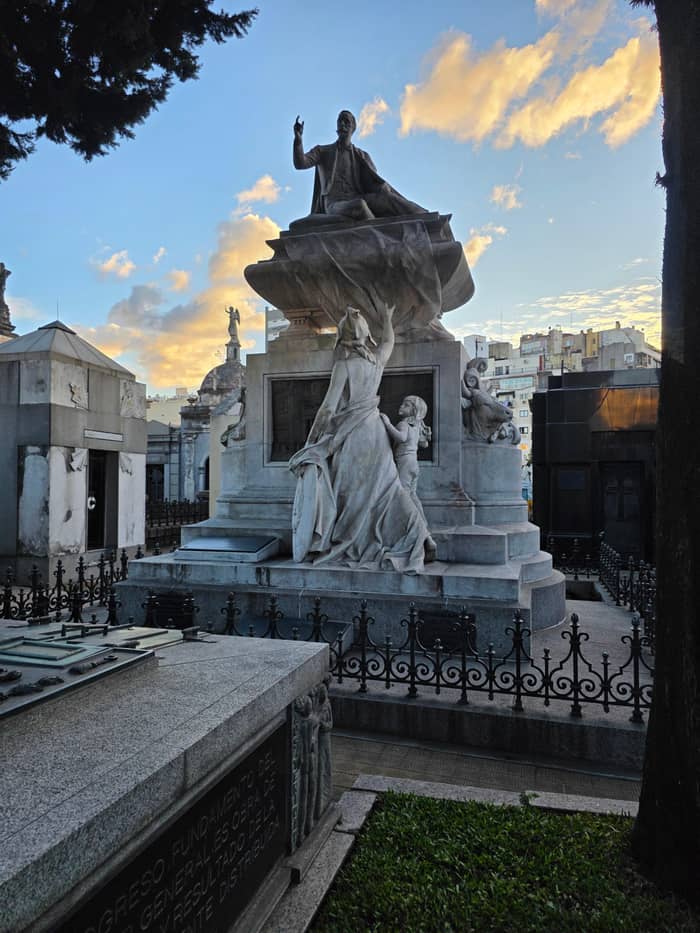
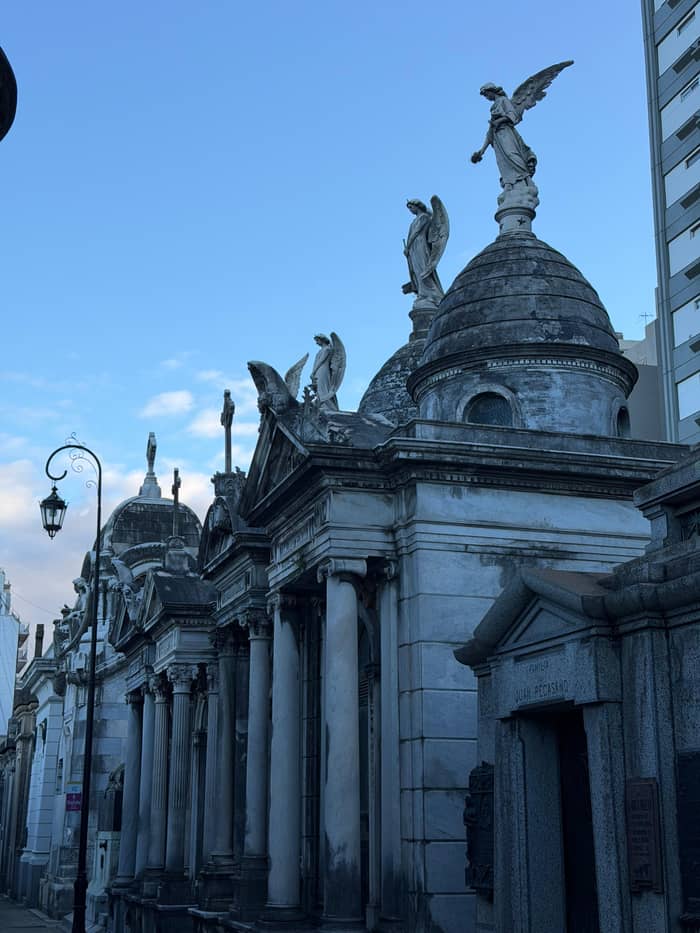
Inside, more than 4500 vaults line the alleys in very varied styles, including Greek temples and even Egyptian pyramids.1 The tourism board lists Art Deco, Art Nouveau, baroque and neo-gothic among them, with Masonic symbols and religious images throughout.2 The vaults, decorated with marble and sculpture, are the work of noted architects and artists, as the city puts it.9

Signed works

Sculptors and the tombs they made

TombSculptorLook for
Domingo F. SarmientoVíctor de PolA condor on an obelisk
Bartolomé MitreEduardo RubinoLiberty, Duty and Justice
Nicolás AvellanedaJules Félix CoutanThe figure of Hope
Carlos PellegriniMerciéA Jockey Club tribute
Ramón FalcónLéon-Ernest DrivierA youth and a sphinx
Francisco MuñizEttore XimenesThe rod of Asclepius
Martín RodríguezArturo DrescoSeated in cape and uniform

From the national monuments commission's guide to the historic tombs of Recoleta.19,20,12,13,21,22,23

Why families built so high

Most Recoleta Cemetery mausoleums date from a boom: the country was rising fast, and its first families tried to outdo each other in marble, the tourism board writes.16 Once the rich settled in the district in the late 19th century, this became the burial ground they preferred.17 The vaults you see are the result: a district's wealth, turned into stone within a few decades.

The national commission describes the same rivalry in architectural terms. Between the end of the 19th century and the start of the 20th, the elite built ever more sumptuous pantheons, competing in height with domes, small temples, sober peristyles and elaborate sculpture.18 The result is a skyline in miniature, where a family's standing could be measured by the height of its cupola.

That competition explains the density you feel in the alleys. Vaults stand shoulder to shoulder, each trying to catch the eye, and the narrow passages between them were never meant to show them off from a distance. To see a facade properly, stand at the end of an alley and look along it, or step back into a crossing where the avenues open up.

A century of taste

How the styles changed

  1. 1810 to 1860

    Neoclassical simplicity

    Plain stones, columns and obelisks.10

  2. 1860 to 1880

    Carrara in the Italian manner

    Grey and white marble, mourning figures.11

  3. From 1881

    A new portico

    Buschiazzo's Greco-Roman entrance.7,8

  4. Turn of the century

    Grand sculpture

    Coutan, Mercié and others sign tombs.12,13

  5. Early 1900s

    Art Nouveau

    Rufina Cambaceres' tomb.14

  6. 1920s

    Art Deco

    A new series of geometric mausoleums.15

The early, simple tombs

The oldest tombs are the quietest. Restraint marks everything from 1810 to 1860, a Neoclassical and Neo-Renaissance plainness best seen in the pantheon of meritorious citizens.10 There, graves for Cornelio de Saavedra, Deán Funes and their contemporaries take the form of plain gravestones, sarcophagi, columns and obelisks topped by urns.25

A few early pieces carry a strong idea in very little stone. San Martín's commission for his wife's grave in 1824 is a single plain slab,26 and the tomb of Nicolás Rodríguez Peña, from 1831, is a truncated column, a classic image of a life cut short.27 Look for these modest shapes between the later palaces.

Egypt arrived early too. The tomb of Miguel de Azcuénaga, from 1833, is a compact block in the form of a mastaba, a fashion that followed Napoleon's excavations in Egypt, and the tomb of Manuel Dorrego is similar.28 When you later see a full pyramid among the vaults, you are looking at the same taste carried much further.

Plan your visit

How to see the best architecture

Match the visit to your eye.

  • If I love sculpture

    Find Falcón, Avellaneda and Muñiz

    Drivier, Coutan and Ximenes signed them.21,12,24

  • If I love Art Nouveau and Art Deco

    Start at Rufina Cambaceres

    Her tomb is Art Nouveau of the early 1900s.14

  • If I want history in the stone

    Begin at the early pantheon

    The Meritorious Citizens pantheon shows the plain early style.10

  • If I want an expert at my side

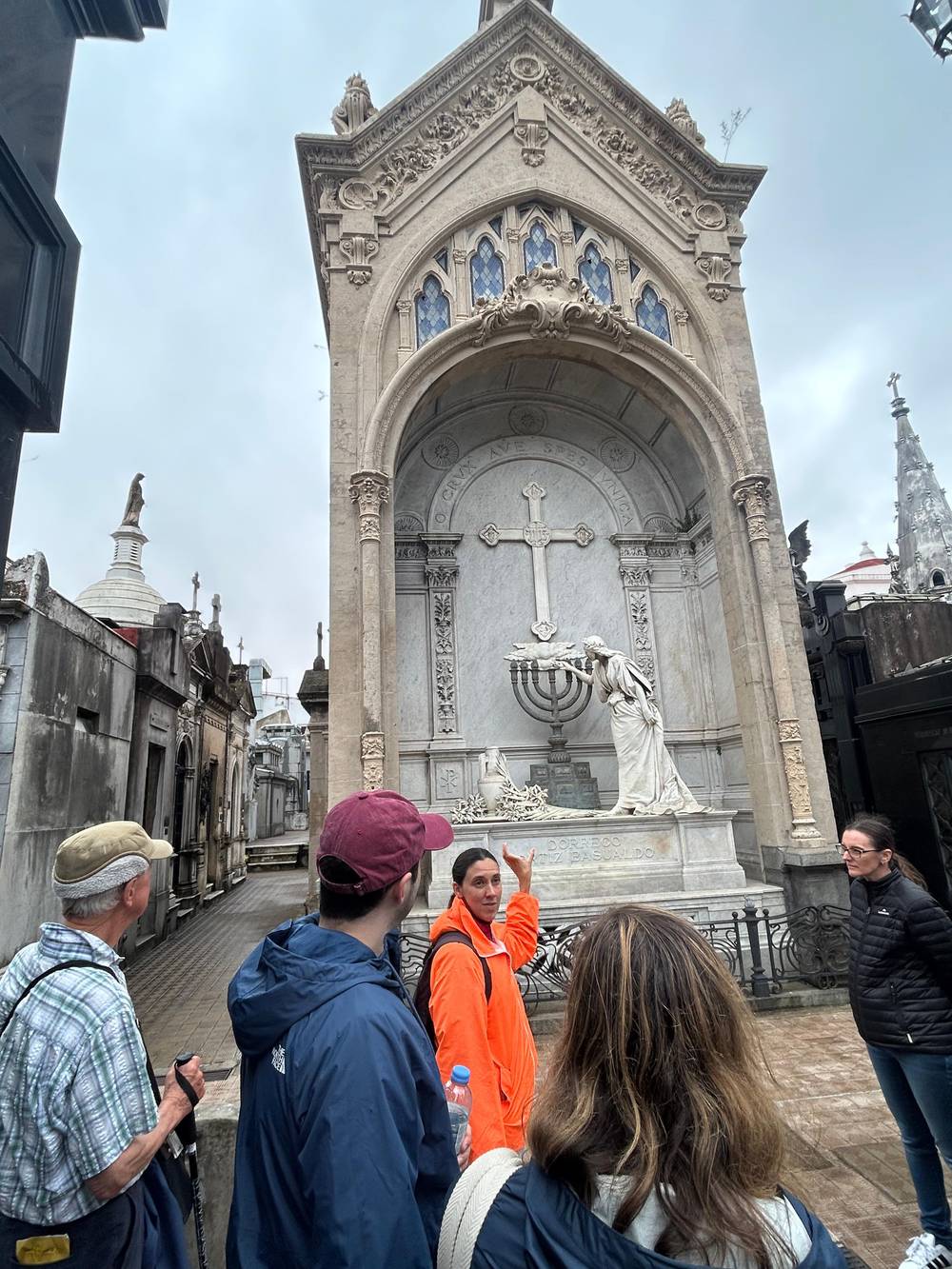
    Book a guided tour

    The English tour lasts 2 hours.

  • If I want time for photos

    Go alone with our map

    The architecture tab marks every tomb on this page.

Styles side by side

Classical, Art Nouveau and Art Deco side by side

Most common

Classical temple

Greco-Roman orders

  • MaterialCarrara marble
  • FiguresMourning women
  • EraLate 19th century
Show me

Early 1900s

Art Nouveau

Soft curves

  • ExampleRufina Cambaceres
  • Built byHer mother
  • Look forFloral lines
Show me

1920s

Art Deco

Geometric lines

  • ShapesStepped and flat
  • DoorsBronze patterns
  • Era1920s
Show me

Carrara marble and the Italian manner

Between 1860 and 1880 the most common type was a compact tomb in grey and white Carrara marble, with Greco-Roman orders and female figures in classical dress, eyes lowered in mourning.11 Once you know the type, you will see it everywhere: a small temple front, a pair of columns and a grieving woman at the door.

Some tombs from these decades are personal statements. The tomb of Juan Martín de Pueyrredón was designed by his son, the engineer, architect and painter Prilidiano Pueyrredon.51 Admiral Brown's is a votive column with a Corinthian capital and a naval trophy, raised by his widow.31 The tomb of Mariquita Sánchez, from 1870, has side columns with crosses and inverted torches.73

And then there is the exception that proves the rule. The grotto-tomb of General Tomás Guido, from about 1866, is a rustic, Romantic oddity among the polished marble, built to look like a cave rather than a temple.50 It is worth the detour precisely because it refuses the fashion of its neighbors, and it reminds you that taste in this cemetery was never as uniform as the marble suggests.

Go with a guide

What an architecture-minded tour costs

Compare guided tours that explain the mausoleums.

Weigh up 3 options

What an architecture-minded tour costs

Compare guided tours that explain the mausoleums.

2 people
  1. English guided tour2 hours · per person starting at $12

    ≈

    View
  2. Small-group tour2.5 hours · per person starting at $59

    ≈

    View
  3. Recoleta walk1 hour inside · per person starting at $57

    ≈

    View

Starting prices on GetYourGuide, exchanged at the ECB reference rate. The booking page gives the exact price.

French and Italian sculptors

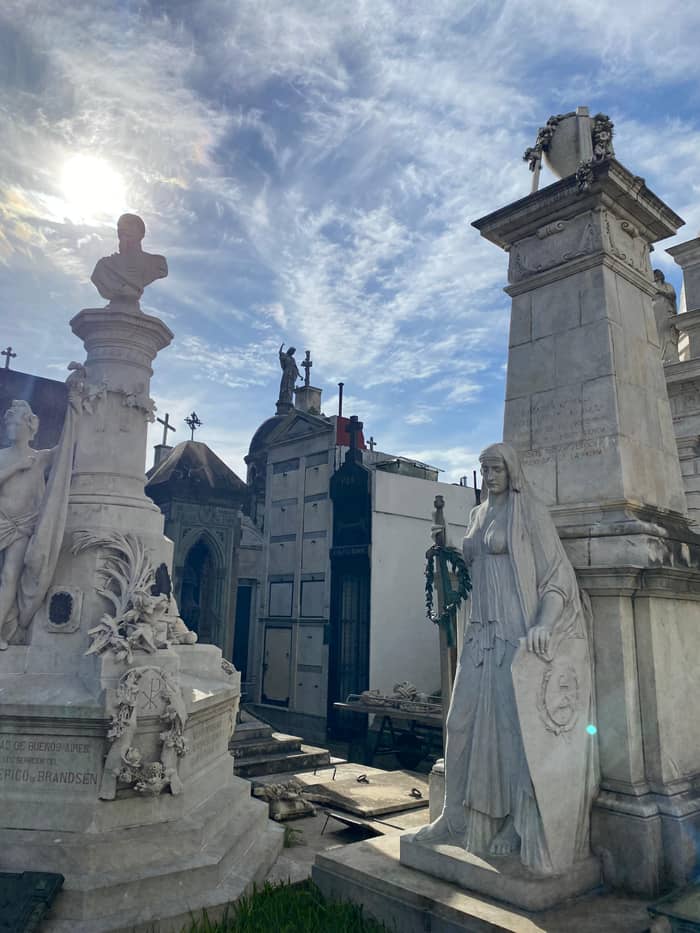
The Recoleta Cemetery statues come from Argentine hands and, above all, from French and Italian studios; the commission traces their lineage to the great cemeteries of Paris and Genoa.3 It describes the whole as funerary art of great merit by noted architects and sculptors of the 19th and 20th centuries.74

Several great names signed tombs here. Jules Félix Coutan made Nicolás Avellaneda's monument in 1908, with a figure of Hope,12 Mercié signed Carlos Pellegrini's mausoleum of 1913,13 and Jean Alexandre Falguière made the cenotaph of Lucio V. López around 1894.75 Drivier, trained by Rodin, set a struggling youth and a sphinx on top of Falcón's mausoleum.21

Italian and Argentine sculptors hold their own. Ettore Ximenes made the monument to Francisco Muñiz,24 where an allegorical figure holds the rod of Asclepius.22 Víctor de Pol made Sarmiento's obelisk in 1889,19 Eduardo Rubino made Mitre's tomb,20 and Arturo Dresco portrayed Governor Martín Rodríguez seated in cape and uniform, in 1924.23

Video
Recoleta Cemetery in Buenos Aires

Kara and Nate on YouTube · Playback files load only once you tap play.

This heritage shows the influence of the funerary art of the cemeteries of Père-Lachaise in Paris and Staglieno in Genoa.
National Commission of Monuments, Places and Historic Assets (Argentina)3

Art Nouveau, Art Deco and a vault in black stone

The new century brought new curves. Rufina Cambaceres' tomb, built in the early 1900s, is the classic Art Nouveau example here: a slender marble girl, curves instead of columns.14 Its soft lines and floral details are easy to compare with the strict classical tombs a few alleys away, and the contrast is the quickest lesson in how taste changed.

In the 1920s a series of mausoleums was built in the Art Deco style, with sharper geometry and stylized figures.15 Look for flat planes, stepped tops and bronze doors with geometric patterns; they read as modern even now. The commission singles out one of them, an Art Deco Pietà by Luis Carlos Rovatti, among the tombs of this period.76

The Paz vault goes the other way: dark stone instead of pale, giant angels, and Freemasons' emblems for a family of press barons.49 It shows how far families pushed the materials, from white Carrara to dark stone, to stand apart from their neighbors. Compare it with the pale classical vaults on either side, and the effect is immediate, even before you notice the angels.

Reading the symbols on a door

Every vault speaks a visual language. Masonic symbols sit beside religious iconography across the cemetery,2 and once you start looking, you find them on doors, pediments and plaques. On the tomb of Pedro Benoit, the planner of La Plata, the sculptor Rafael Hernández included the Masonic square and compass.72 Sarmiento's obelisk is itself a Masonic form.19

Classical allegories are the most common figures. Mitre's tomb has Liberty, Duty and Justice,20 Avellaneda's the figure of Hope,12 and Adolfo Alsina's mausoleum of 1915 carries reliefs by Margarita Bonnet, finished by Ernesto Dungon.54 Inverted torches, as on Mariquita Sánchez's tomb, stand for a life put out,73 while urns, wreaths and truncated columns speak of death and memory.

Bring your eyes up and down. Look at the cupolas and finials, then at the bronze handles, keyholes and glass behind the doors. Photograph in soft morning light, when the marble glows and the shadows are gentle, and never step inside a vault, lean on a door or touch a sculpture. These are family graves, and many are protected heritage.

FAQ

Questions answered quickly.

What architectural styles are in Recoleta Cemetery?
Many, side by side.

The tourism board names Art Deco, Art Nouveau, baroque and neo-gothic, and the city adds Greek temples and Egyptian pyramids.2,1

How many Recoleta Cemetery mausoleums are there?
More than 4500 vaults.

They line the alleys in very varied styles.1

Who made the Recoleta Cemetery statues?
Argentine and European sculptors.

French and Italian artists are especially well represented.3

Which is the most famous sculpture?
Opinions differ.

Strong candidates are Rufina Cambaceres' Art Nouveau tomb and Falcón's sphinx by a pupil of Rodin.14,21

Who designed the cemetery?
Próspero Catelin, in 1822.

Juan Antonio Buschiazzo reformed it from 1881.6,7

Are the mausoleums protected?
Many are.

National monument status covers over 90 vaults.4

What do the symbols on the doors mean?
Faith, Freemasonry and memory.

Masonic symbols appear beside religious images across the cemetery.2

Sources

  1. City of Buenos Aires · Cementerio de la Recoleta ↩
  2. Buenos Aires City Tourism Board · Recoleta Cemetery ↩
  3. National Commission of Monuments, Places and Historic Assets (Argentina) · Guia de Monumentos Historicos Nacionales, Ciudad de Buenos Aires, parte 2 (PDF, pp. 315-324: Cementerio de la Recoleta, Sepulcros Historicos) ↩
  4. City of Buenos Aires · Cementerio de la Recoleta ↩
  5. National Commission of Monuments, Places and Historic Assets (Argentina) · Guia de Monumentos Historicos Nacionales, Ciudad de Buenos Aires, parte 2 (PDF, pp. 315-324: Cementerio de la Recoleta, Sepulcros Historicos) ↩
  6. City of Buenos Aires · Cementerio de la Recoleta ↩
  7. National Commission of Monuments, Places and Historic Assets (Argentina) · Guia de Monumentos Historicos Nacionales, Ciudad de Buenos Aires, parte 2 (PDF, pp. 315-324: Cementerio de la Recoleta, Sepulcros Historicos) ↩
  8. National Commission of Monuments, Places and Historic Assets (Argentina) · Guia de Monumentos Historicos Nacionales, Ciudad de Buenos Aires, parte 2 (PDF, pp. 315-324: Cementerio de la Recoleta, Sepulcros Historicos) ↩
  9. City of Buenos Aires · Cementerio de la Recoleta ↩
  10. National Commission of Monuments, Places and Historic Assets (Argentina) · Guia de Monumentos Historicos Nacionales, Ciudad de Buenos Aires, parte 2 (PDF, pp. 315-324: Cementerio de la Recoleta, Sepulcros Historicos) ↩
  11. National Commission of Monuments, Places and Historic Assets (Argentina) · Guia de Monumentos Historicos Nacionales, Ciudad de Buenos Aires, parte 2 (PDF, pp. 315-324: Cementerio de la Recoleta, Sepulcros Historicos) ↩
  12. National Commission of Monuments, Places and Historic Assets (Argentina) · Guia de Monumentos Historicos Nacionales, Ciudad de Buenos Aires, parte 2 (PDF, pp. 315-324: Cementerio de la Recoleta, Sepulcros Historicos) ↩
  13. National Commission of Monuments, Places and Historic Assets (Argentina) · Guia de Monumentos Historicos Nacionales, Ciudad de Buenos Aires, parte 2 (PDF, pp. 315-324: Cementerio de la Recoleta, Sepulcros Historicos) ↩
  14. Buenos Aires City Tourism Board · Recoleta Cemetery ↩
  15. National Commission of Monuments, Places and Historic Assets (Argentina) · Guia de Monumentos Historicos Nacionales, Ciudad de Buenos Aires, parte 2 (PDF, pp. 315-324: Cementerio de la Recoleta, Sepulcros Historicos) ↩
  16. Buenos Aires City Tourism Board · Cementerio de la Recoleta ↩
  17. Buenos Aires City Tourism Board · Cementerio de la Recoleta ↩
  18. National Commission of Monuments, Places and Historic Assets (Argentina) · Guia de Monumentos Historicos Nacionales, Ciudad de Buenos Aires, parte 2 (PDF, pp. 315-324: Cementerio de la Recoleta, Sepulcros Historicos) ↩
  19. National Commission of Monuments, Places and Historic Assets (Argentina) · Guia de Monumentos Historicos Nacionales, Ciudad de Buenos Aires, parte 2 (PDF, pp. 315-324: Cementerio de la Recoleta, Sepulcros Historicos) ↩
  20. National Commission of Monuments, Places and Historic Assets (Argentina) · Guia de Monumentos Historicos Nacionales, Ciudad de Buenos Aires, parte 2 (PDF, pp. 315-324: Cementerio de la Recoleta, Sepulcros Historicos) ↩
  21. National Commission of Monuments, Places and Historic Assets (Argentina) · Guia de Monumentos Historicos Nacionales, Ciudad de Buenos Aires, parte 2 (PDF, pp. 315-324: Cementerio de la Recoleta, Sepulcros Historicos) ↩
  22. National Commission of Monuments, Places and Historic Assets (Argentina) · Guia de Monumentos Historicos Nacionales, Ciudad de Buenos Aires, parte 2 (PDF, pp. 315-324: Cementerio de la Recoleta, Sepulcros Historicos) ↩
  23. National Commission of Monuments, Places and Historic Assets (Argentina) · Guia de Monumentos Historicos Nacionales, Ciudad de Buenos Aires, parte 2 (PDF, pp. 315-324: Cementerio de la Recoleta, Sepulcros Historicos) ↩
  24. National Commission of Monuments, Places and Historic Assets (Argentina) · Guia de Monumentos Historicos Nacionales, Ciudad de Buenos Aires, parte 2 (PDF, pp. 315-324: Cementerio de la Recoleta, Sepulcros Historicos) ↩
  25. National Commission of Monuments, Places and Historic Assets (Argentina) · Guia de Monumentos Historicos Nacionales, Ciudad de Buenos Aires, parte 2 (PDF, pp. 315-324: Cementerio de la Recoleta, Sepulcros Historicos) ↩
  26. National Commission of Monuments, Places and Historic Assets (Argentina) · Guia de Monumentos Historicos Nacionales, Ciudad de Buenos Aires, parte 2 (PDF, pp. 315-324: Cementerio de la Recoleta, Sepulcros Historicos) ↩
  27. National Commission of Monuments, Places and Historic Assets (Argentina) · Guia de Monumentos Historicos Nacionales, Ciudad de Buenos Aires, parte 2 (PDF, pp. 315-324: Cementerio de la Recoleta, Sepulcros Historicos) ↩
  28. National Commission of Monuments, Places and Historic Assets (Argentina) · Guia de Monumentos Historicos Nacionales, Ciudad de Buenos Aires, parte 2 (PDF, pp. 315-324: Cementerio de la Recoleta, Sepulcros Historicos) ↩
  29. Buenos Aires City Tourism Board · Recoleta Cemetery
  30. Buenos Aires City Tourism Board · Recoleta Cemetery
  31. National Commission of Monuments, Places and Historic Assets (Argentina) · Guia de Monumentos Historicos Nacionales, Ciudad de Buenos Aires, parte 2 (PDF, pp. 315-324: Cementerio de la Recoleta, Sepulcros Historicos) ↩
  32. National Commission of Monuments, Places and Historic Assets (Argentina) · Sepulcro de Guillermo Brown
  33. National Commission of Monuments, Places and Historic Assets (Argentina) · Sepulcro de Miguel de Azcuenaga
  34. National Commission of Monuments, Places and Historic Assets (Argentina) · Guia de Monumentos Historicos Nacionales, Ciudad de Buenos Aires, parte 2 (PDF, pp. 315-324: Cementerio de la Recoleta, Sepulcros Historicos)
  35. Buenos Aires City Tourism Board · The lady in white at Recoleta Cemetery
  36. City of Buenos Aires · Cementerio de la Recoleta
  37. Buenos Aires City Tourism Board · Recoleta Cemetery
  38. Buenos Aires City Tourism Board · Recoleta Cemetery
  39. Museo Evita (Instituto Nacional de Investigaciones Historicas Eva Peron) · El derrotero del cuerpo de Eva
  40. Museo Evita (Instituto Nacional de Investigaciones Historicas Eva Peron) · El derrotero del cuerpo de Eva
  41. Buenos Aires City Tourism Board · An aristocratic cemetery
  42. Buenos Aires City Tourism Board · Recoleta Cemetery
  43. Nobel Prize Outreach (NobelPrize.org) · Luis Leloir: Facts
  44. National Commission of Monuments, Places and Historic Assets (Argentina) · Guia de Monumentos Historicos Nacionales, Ciudad de Buenos Aires, parte 2 (PDF, pp. 315-324: Cementerio de la Recoleta, Sepulcros Historicos)
  45. National Commission of Monuments, Places and Historic Assets (Argentina) · Guia de Monumentos Historicos Nacionales, Ciudad de Buenos Aires, parte 2 (PDF, pp. 315-324: Cementerio de la Recoleta, Sepulcros Historicos)
  46. National Commission of Monuments, Places and Historic Assets (Argentina) · Guia de Monumentos Historicos Nacionales, Ciudad de Buenos Aires, parte 2 (PDF, pp. 315-324: Cementerio de la Recoleta, Sepulcros Historicos)
  47. Buenos Aires City Tourism Board · Recoleta Cemetery (Buenos Aires in 24 hours)
  48. Buenos Aires City Tourism Board · Recoleta Cemetery
  49. Buenos Aires City Tourism Board · Recoleta Cemetery ↩
  50. National Commission of Monuments, Places and Historic Assets (Argentina) · Guia de Monumentos Historicos Nacionales, Ciudad de Buenos Aires, parte 2 (PDF, pp. 315-324: Cementerio de la Recoleta, Sepulcros Historicos) ↩
  51. National Commission of Monuments, Places and Historic Assets (Argentina) · Guia de Monumentos Historicos Nacionales, Ciudad de Buenos Aires, parte 2 (PDF, pp. 315-324: Cementerio de la Recoleta, Sepulcros Historicos) ↩
  52. National Commission of Monuments, Places and Historic Assets (Argentina) · Sepulcro de Luis Vernet
  53. National Commission of Monuments, Places and Historic Assets (Argentina) · Sepulcro de Emma Nicolay de Caprile
  54. National Commission of Monuments, Places and Historic Assets (Argentina) · Guia de Monumentos Historicos Nacionales, Ciudad de Buenos Aires, parte 2 (PDF, pp. 315-324: Cementerio de la Recoleta, Sepulcros Historicos) ↩
  55. Buenos Aires City Tourism Board · Basilica de Nuestra Senora del Pilar
  56. Buenos Aires City Tourism Board (turismo.buenosaires.gob.ar) · Recoleta Cultural Centre
  57. Buenos Aires City Tourism Board (turismo.buenosaires.gob.ar) · Recoleta Cultural Centre
  58. Buenos Aires City Tourism Board (turismo.buenosaires.gob.ar) · La Biela
  59. Buenos Aires City Tourism Board (turismo.buenosaires.gob.ar) · La Biela
  60. Buenos Aires City Tourism Board · Legends of Recoleta
  61. Buenos Aires City Tourism Board (turismo.buenosaires.gob.ar) · Recoleta Tourist Assistance Center
  62. Government of the City of Buenos Aires (buenosaires.gob.ar) · Barrio de Recoleta (self-guided circuit)
  63. Buenos Aires City Tourism Board (turismo.buenosaires.gob.ar) · Plaza Francia
  64. Buenos Aires City Tourism Board (turismo.buenosaires.gob.ar) · Plaza Francia
  65. Buenos Aires City Tourism Board (turismo.buenosaires.gob.ar) · Museo Nacional de Bellas Artes
  66. Buenos Aires City Tourism Board (turismo.buenosaires.gob.ar) · Floralis Generica
  67. Buenos Aires City Tourism Board (turismo.buenosaires.gob.ar) · Floralis Generica
  68. Buenos Aires City Tourism Board (turismo.buenosaires.gob.ar) · Faculty of Law
  69. Buenos Aires City Tourism Board · Evita's resting place
  70. Buenos Aires City Tourism Board (turismo.buenosaires.gob.ar) · Biblioteca Nacional (National Library)
  71. Buenos Aires City Tourism Board (turismo.buenosaires.gob.ar) · 9.30am | Recoleta Cemetery
  72. National Commission of Monuments, Places and Historic Assets (Argentina) · Guia de Monumentos Historicos Nacionales, Ciudad de Buenos Aires, parte 2 (PDF, pp. 315-324: Cementerio de la Recoleta, Sepulcros Historicos) ↩
  73. National Commission of Monuments, Places and Historic Assets (Argentina) · Guia de Monumentos Historicos Nacionales, Ciudad de Buenos Aires, parte 2 (PDF, pp. 315-324: Cementerio de la Recoleta, Sepulcros Historicos) ↩
  74. National Commission of Monuments, Places and Historic Assets (Argentina) · Guia de Monumentos Historicos Nacionales, Ciudad de Buenos Aires, parte 2 (PDF, pp. 315-324: Cementerio de la Recoleta, Sepulcros Historicos) ↩
  75. National Commission of Monuments, Places and Historic Assets (Argentina) · Guia de Monumentos Historicos Nacionales, Ciudad de Buenos Aires, parte 2 (PDF, pp. 315-324: Cementerio de la Recoleta, Sepulcros Historicos) ↩
  76. National Commission of Monuments, Places and Historic Assets (Argentina) · Guia de Monumentos Historicos Nacionales, Ciudad de Buenos Aires, parte 2 (PDF, pp. 315-324: Cementerio de la Recoleta, Sepulcros Historicos) ↩

Before you go

Hold your place, pay later.

Hold your place on the guided visit today and pay nothing yet; plans can still change free of charge while a day or more remains.

Check dates