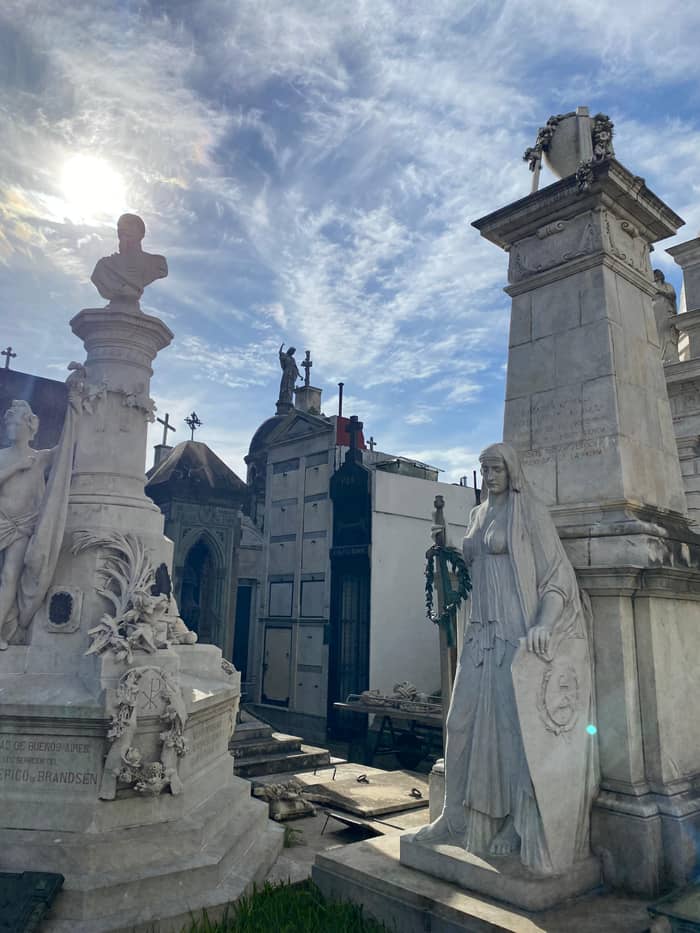
Colonial church
Basilica del Pilar
Next to the gate
- Opened1732
- InsideBaroque altarpiece
- OpenEvery day
Map your stop
See 41 route stops
Pick a route, then tap a marker or a stop for notes and a Google Maps link.
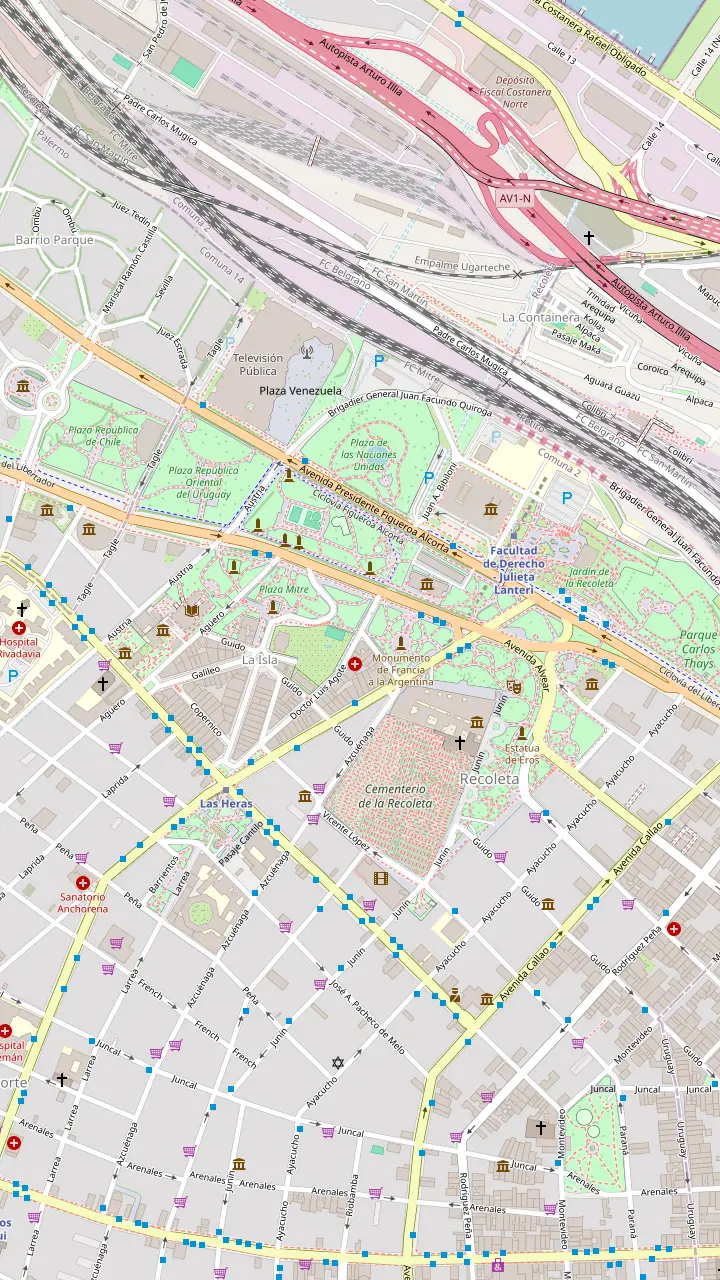
Junín 1760: the entrance for visitors, where the English tour meets by the ticket booth and free maps are handed out.
Google MapsThe white colonial church next to the gate, opened in 1732.
Google MapsThe former Recollect convent, now an arts centre with 27 exhibition rooms.
Google MapsConsidered the oldest café in the city, facing the cemetery and Plaza Francia.
Google MapsThe great gomero tree, its branches spreading 50 meters across.
Google MapsThe city's tourist assistance centre, open every day from 9 AM to 6 PM.
Google MapsThe weekend craft fair, held Saturdays, Sundays and holidays.
Google MapsNamed after the monument the French community gave for the centenary of 1910.
Google MapsHome of the largest collection of Argentine art.
Google MapsThe steel flower of 20 m whose petals open in the morning and close at midnight.
Google MapsThe University of Buenos Aires law school, a neoclassical building of 1949.
Google MapsBuilt on the site of the Perons' presidential residence, with a city view from its fifth floor.
Google MapsSubte line H, at the corner of Las Heras and Pueyrredón.
Google Maps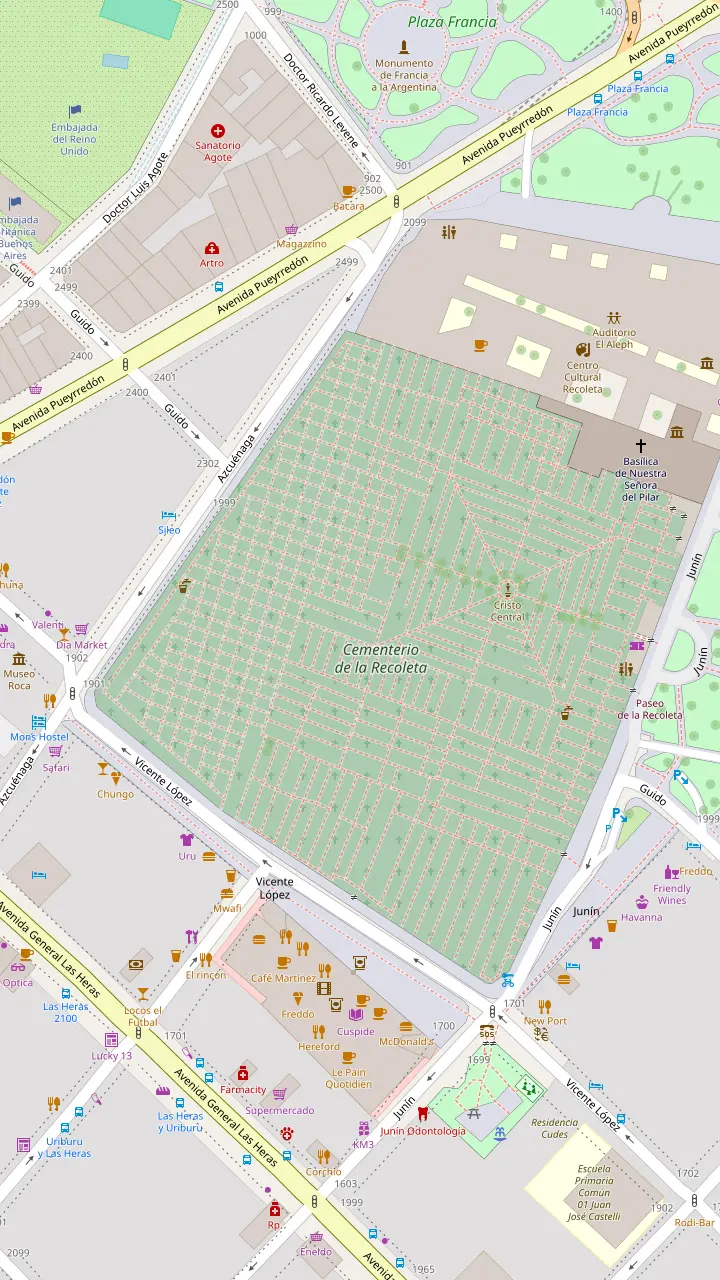
Junín 1760: the entrance for visitors, where the English tour meets by the ticket booth and free maps are handed out.
Google MapsThe bronze Christ at the crossing of the central avenues: an easy landmark to regroup at if you lose your way in the alleys.
Google MapsSimple tombs of the early republic: Cornelio de Saavedra, Antonio Sáenz and Deán Funes are honored here.
Google MapsA votive column with a naval trophy, raised by his widow Elizabeth Chitty for the Irish-born admiral.
Google MapsA compact tomb in the Egyptian mastaba manner, like that of Miguel de Azcuénaga.
Google MapsDesigned by Alejandro Christophersen; it also holds Torcuato de Alvear, the mayor who reformed the cemetery.
Google MapsThe vault of Luz María, the playwright's daughter who died in 1925 aged 15, and the source of the lady in white legend.
Google MapsThe writer's vault is among the most visited in the cemetery, the city says.
Google MapsAn Art Nouveau tomb of the early 1900s in white marble, raised by her mother.
Google MapsHer bedroom recreated inside, and a bronze of her in her wedding dress with her dog at the door.
Google MapsEduardo Rubino's tomb for the president, with figures of Liberty, Duty and Justice.
Google MapsVíctor de Pol's Masonic obelisk of 1889, crowned by a condor with open wings.
Google MapsEvita's resting place since 1976, the most visited tomb in the cemetery.
Google MapsJules Félix Coutan's sculpture of 1908: a portrait medallion and the figure of Hope.
Google MapsCrowned by a young man fighting a sphinx, carved by Léon-Ernest Drivier, a pupil of Rodin.
Google MapsThe caretaker who saved for his own tomb and statue over 30 years of work here.
Google MapsEttore Ximenes' monument to the doctor who died treating yellow fever patients in 1871.
Google MapsThe vault of the chemist who won the Nobel Prize in Chemistry 1970.
Google MapsThe family vault of the president, set where two avenues cross, with a small atrium.
Google MapsSigned by the French sculptor Mercié and raised in 1913 by the Jockey Club for its founder.
Google MapsHolds Leandro Alem, Hipólito Yrigoyen and Arturo Illia; designed by Ulrico Courtois in 1892.
Google MapsHis bust faces away from his wife's, at her own wish.
Google MapsThe tomb of the former president is among the three the tourism board names as most visited.
Google Maps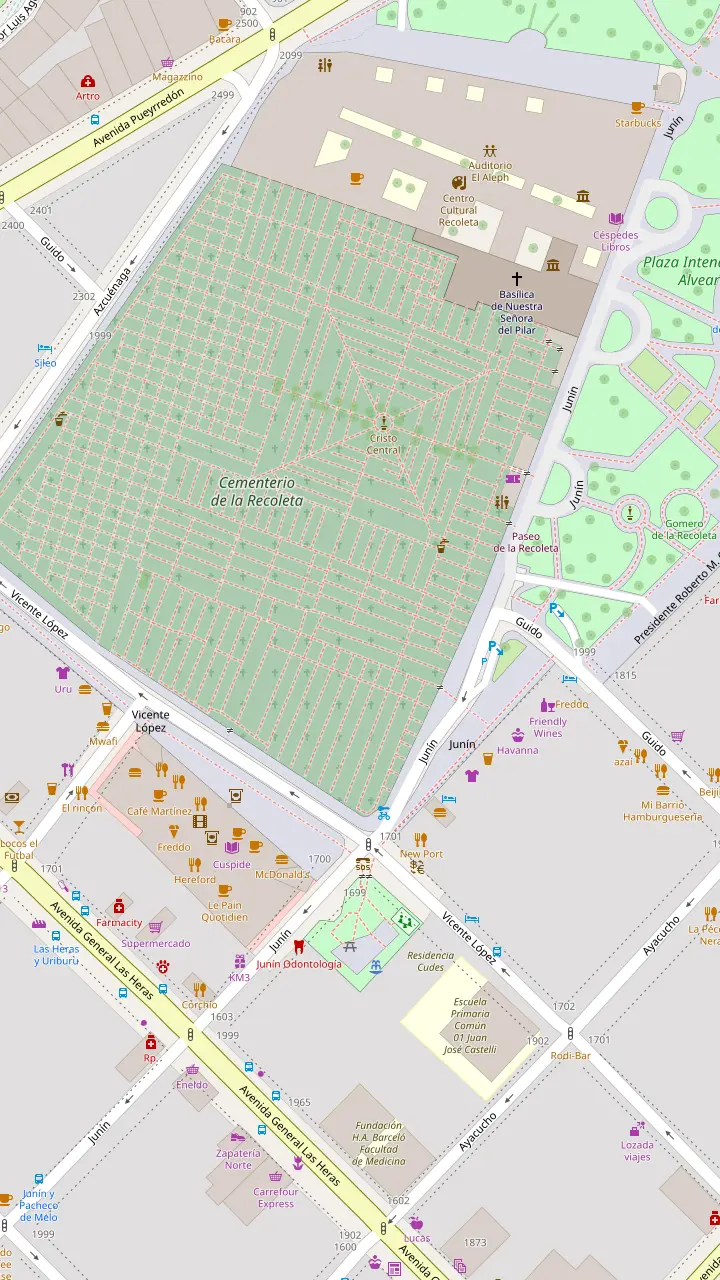
Junín 1760: the entrance for visitors, where the English tour meets by the ticket booth and free maps are handed out.
Google MapsAn Art Nouveau tomb of the early 1900s in white marble, raised by her mother.
Google MapsHer bedroom recreated inside, and a bronze of her in her wedding dress with her dog at the door.
Google MapsEduardo Rubino's tomb for the president, with figures of Liberty, Duty and Justice.
Google MapsVíctor de Pol's Masonic obelisk of 1889, crowned by a condor with open wings.
Google MapsEvita's resting place since 1976, the most visited tomb in the cemetery.
Google Maps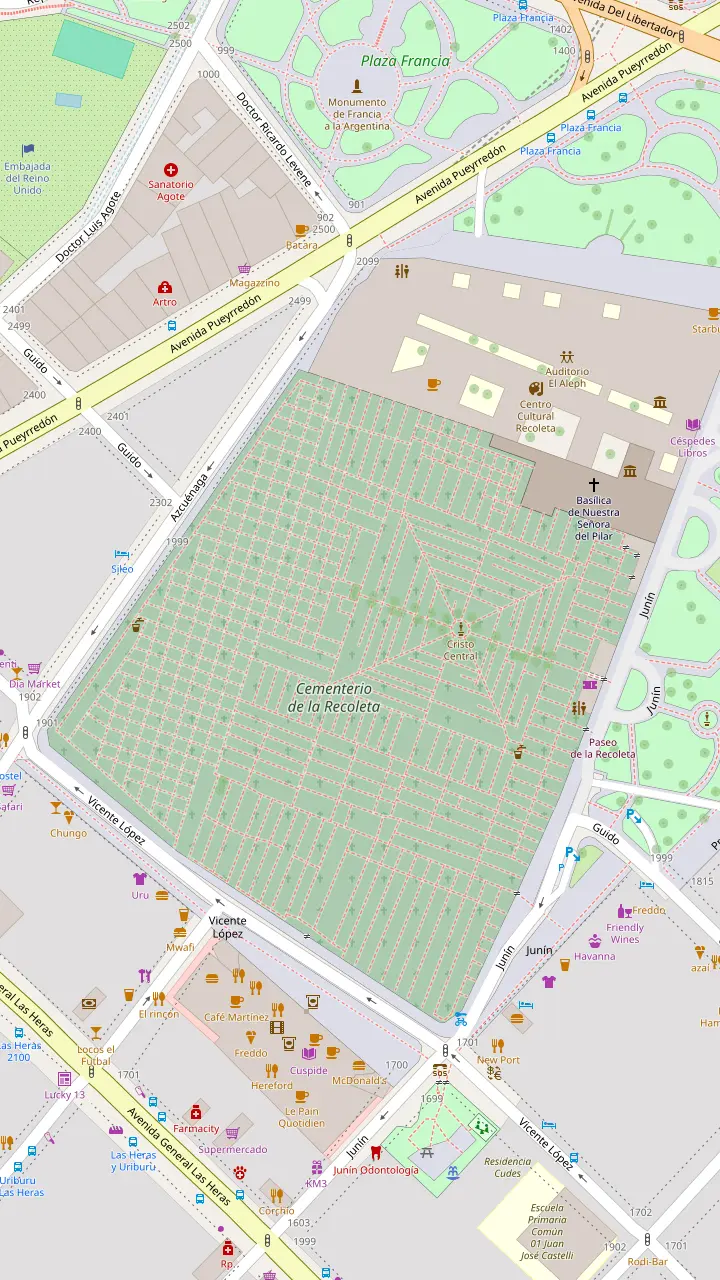
Junín 1760: the entrance for visitors, where the English tour meets by the ticket booth and free maps are handed out.
Google MapsA votive column with a naval trophy, raised by his widow Elizabeth Chitty for the Irish-born admiral.
Google MapsA compact tomb in the Egyptian mastaba manner, like that of Miguel de Azcuénaga.
Google MapsThe writer's vault is among the most visited in the cemetery, the city says.
Google MapsEduardo Rubino's tomb for the president, with figures of Liberty, Duty and Justice.
Google MapsVíctor de Pol's Masonic obelisk of 1889, crowned by a condor with open wings.
Google MapsEvita's resting place since 1976, the most visited tomb in the cemetery.
Google MapsJules Félix Coutan's sculpture of 1908: a portrait medallion and the figure of Hope.
Google MapsThe vault of the chemist who won the Nobel Prize in Chemistry 1970.
Google MapsThe family vault of the president, set where two avenues cross, with a small atrium.
Google MapsSigned by the French sculptor Mercié and raised in 1913 by the Jockey Club for its founder.
Google MapsHolds Leandro Alem, Hipólito Yrigoyen and Arturo Illia; designed by Ulrico Courtois in 1892.
Google MapsHis bust faces away from his wife's, at her own wish.
Google MapsThe tomb of the former president is among the three the tourism board names as most visited.
Google MapsThe first Argentine political and military commander of the Malvinas.
Google MapsThe founding director of a leading teacher-training school, who died in 1884.
Google MapsSarmiento's vice president, in a mausoleum of 1915 by Margarita Bonnet.
Google Maps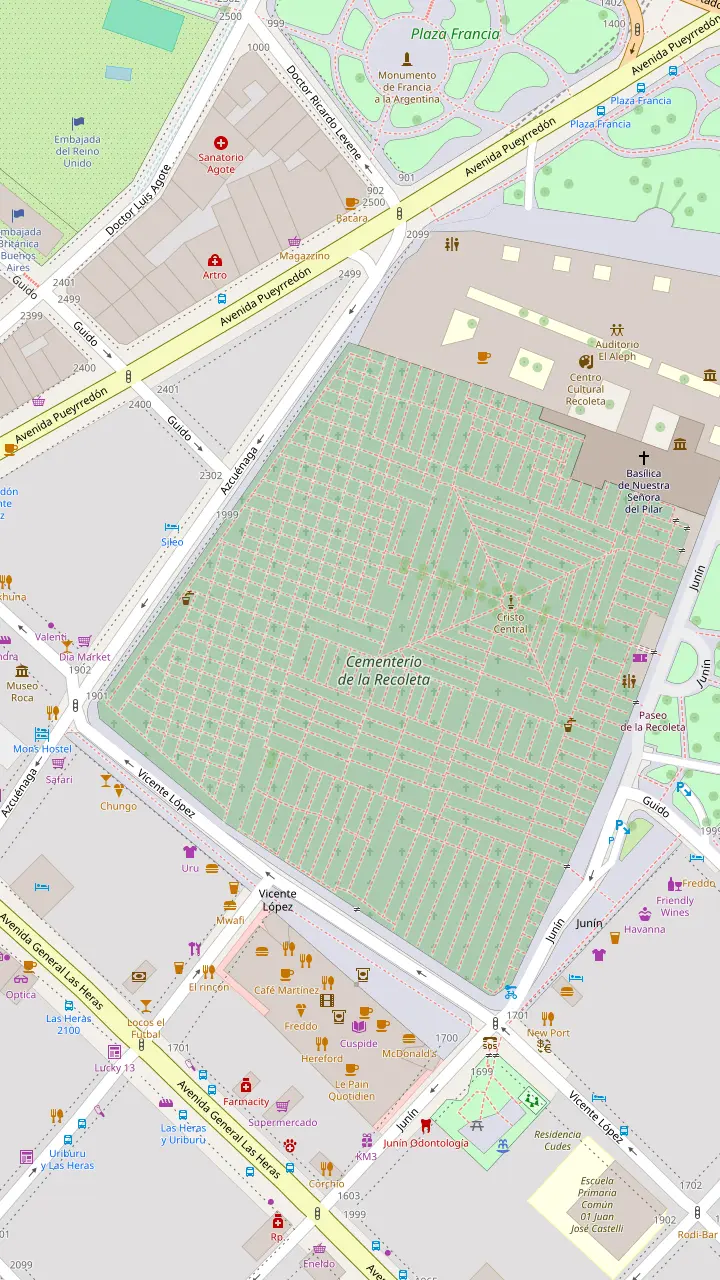
Junín 1760: the entrance for visitors, where the English tour meets by the ticket booth and free maps are handed out.
Google MapsThe vault of Luz María, the playwright's daughter who died in 1925 aged 15, and the source of the lady in white legend.
Google MapsAn Art Nouveau tomb of the early 1900s in white marble, raised by her mother.
Google MapsHer bedroom recreated inside, and a bronze of her in her wedding dress with her dog at the door.
Google MapsCrowned by a young man fighting a sphinx, carved by Léon-Ernest Drivier, a pupil of Rodin.
Google MapsThe caretaker who saved for his own tomb and statue over 30 years of work here.
Google MapsHis bust faces away from his wife's, at her own wish.
Google MapsBlack stone, huge marble angels and Masonic imagery for the family that owned La Prensa.
Google MapsA rustic grotto-tomb of about 1866, a Romantic oddity among the marble.
Google Maps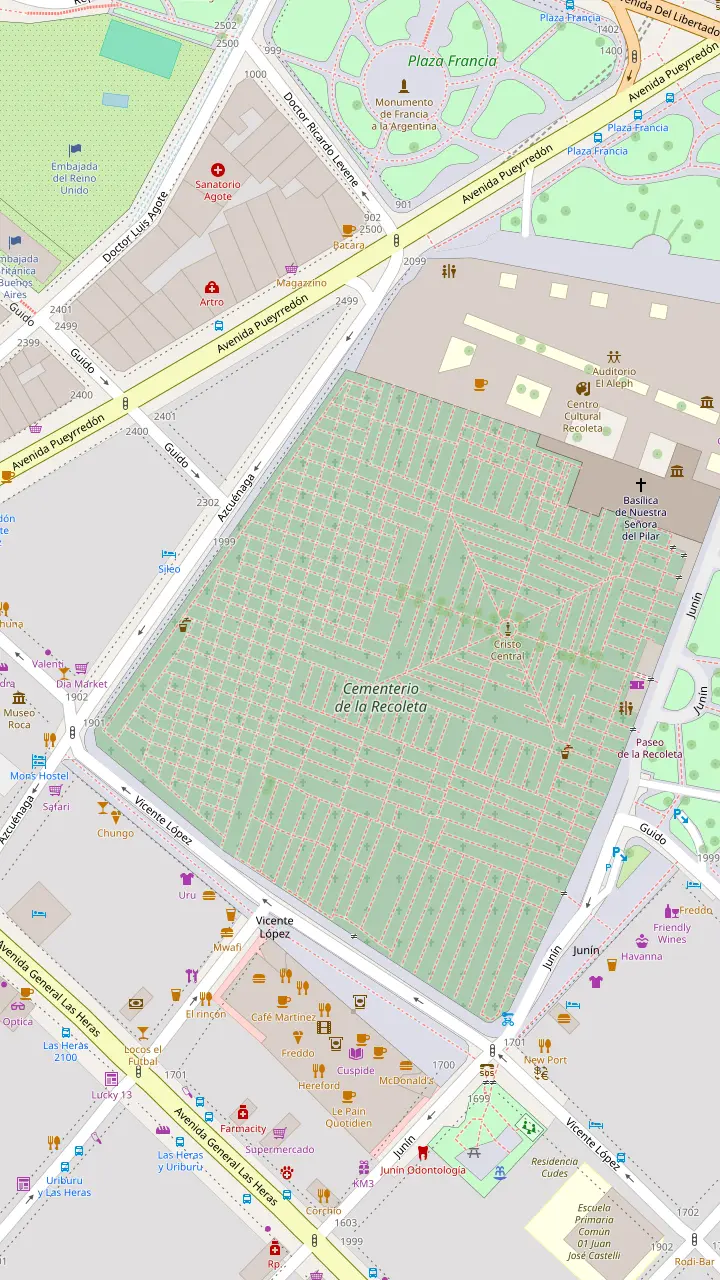
Junín 1760: the entrance for visitors, where the English tour meets by the ticket booth and free maps are handed out.
Google MapsSimple tombs of the early republic: Cornelio de Saavedra, Antonio Sáenz and Deán Funes are honored here.
Google MapsA votive column with a naval trophy, raised by his widow Elizabeth Chitty for the Irish-born admiral.
Google MapsDesigned by Alejandro Christophersen; it also holds Torcuato de Alvear, the mayor who reformed the cemetery.
Google MapsAn Art Nouveau tomb of the early 1900s in white marble, raised by her mother.
Google MapsVíctor de Pol's Masonic obelisk of 1889, crowned by a condor with open wings.
Google MapsJules Félix Coutan's sculpture of 1908: a portrait medallion and the figure of Hope.
Google MapsCrowned by a young man fighting a sphinx, carved by Léon-Ernest Drivier, a pupil of Rodin.
Google MapsEttore Ximenes' monument to the doctor who died treating yellow fever patients in 1871.
Google MapsSigned by the French sculptor Mercié and raised in 1913 by the Jockey Club for its founder.
Google MapsHolds Leandro Alem, Hipólito Yrigoyen and Arturo Illia; designed by Ulrico Courtois in 1892.
Google MapsA rustic grotto-tomb of about 1866, a Romantic oddity among the marble.
Google MapsDesigned by his son, the painter and architect Prilidiano Pueyrredon.
Google MapsSarmiento's vice president, in a mausoleum of 1915 by Margarita Bonnet.
Google MapsBase map © OpenStreetMap contributors
The gate is on Junin street in the middle of Recoleta, and the basilica, the cultural centre, the craft fair and the fine arts museum are all within a short walk of it.
Editorial team, recoletacemeterytour.click · Updated November 9, 2026 · A 7 min read
Main facts
How to get to Recoleta Cemetery depends on where you are staying, but every route ends at the same gate: Junin 1760, in the heart of the Recoleta district.1 Look for the four columns that mark the entrance, with the white basilica on one side and the green squares of Plaza Francia spreading out below.2 The English tour sold on this site meets right there, its guide waiting beside the ticket booth.
For planning a route, the city offers BA Como llego, an online map and app that suggests the way from any address by public transport, by car or on foot.7 Enter the cemetery's address as your destination and it will compare options for you. It is the simplest tool for working out the trip from a hotel in Palermo, San Telmo or the centre.
Recoleta also rewards arriving on foot. The tourism board lists it, with San Telmo, Palermo and the downtown microcentro, among the districts that reward walking at your own pace.8 If you are staying within a few kilometres, walking in along Avenida Alvear, past its mansions, is part of the experience.9
Next door
| Place | Address | Open | Why go |
|---|---|---|---|
| Basilica del Pilar | Junin 1898 | Every day | Baroque altarpiece |
| Cultural centre | Junin 1930 | Tuesday to Sunday | Old convent, exhibitions |
| Craft fair | Pueyrredon 1113 | Weekends, holidays | Handmade crafts |
| Fine arts museum | Libertador 1473 | Tuesday to Sunday | Argentine art |
| National Library | Aguero 2502 | Every day | Fifth-floor view |
| El Ateneo bookstore | Santa Fe 1860 | Every day | Theatre bookstore |
Addresses and opening days from the city's self-guided Recoleta circuit.11,19,20,13,21,22
The underground, called the subte, has six lines, A, B, C, D, E and H.15 For Recoleta, the tourism board's own itinerary uses line H at Las Heras station, at the corner of Las Heras and Avenida Pueyrredon, a walk of several blocks from the cemetery gate.3 From the station, walk towards Plaza Francia and the white bell tower of the basilica, which you will see above the trees before you reach the gate.
Neither the subte nor the buses take cash: you tap a SUBE card that you top up with credit.4 You can pick one up at any subte station, at kiosks all over town, or at one of the eight city tourist offices.16 There is even a machine for recharging SUBE cards at the Recoleta tourist office, handy for the ride onwards.17
Taxis are easy to find. Licensed taxis run on meters and charge only in Argentine pesos, and you can also book one with the city government's BA Taxi app.5,18 Ask for the cemetery on Junin street, and keep a few small notes ready for the fare. Coming back, the taxi stands and avenues around Plaza Francia make it simple to pick one up.
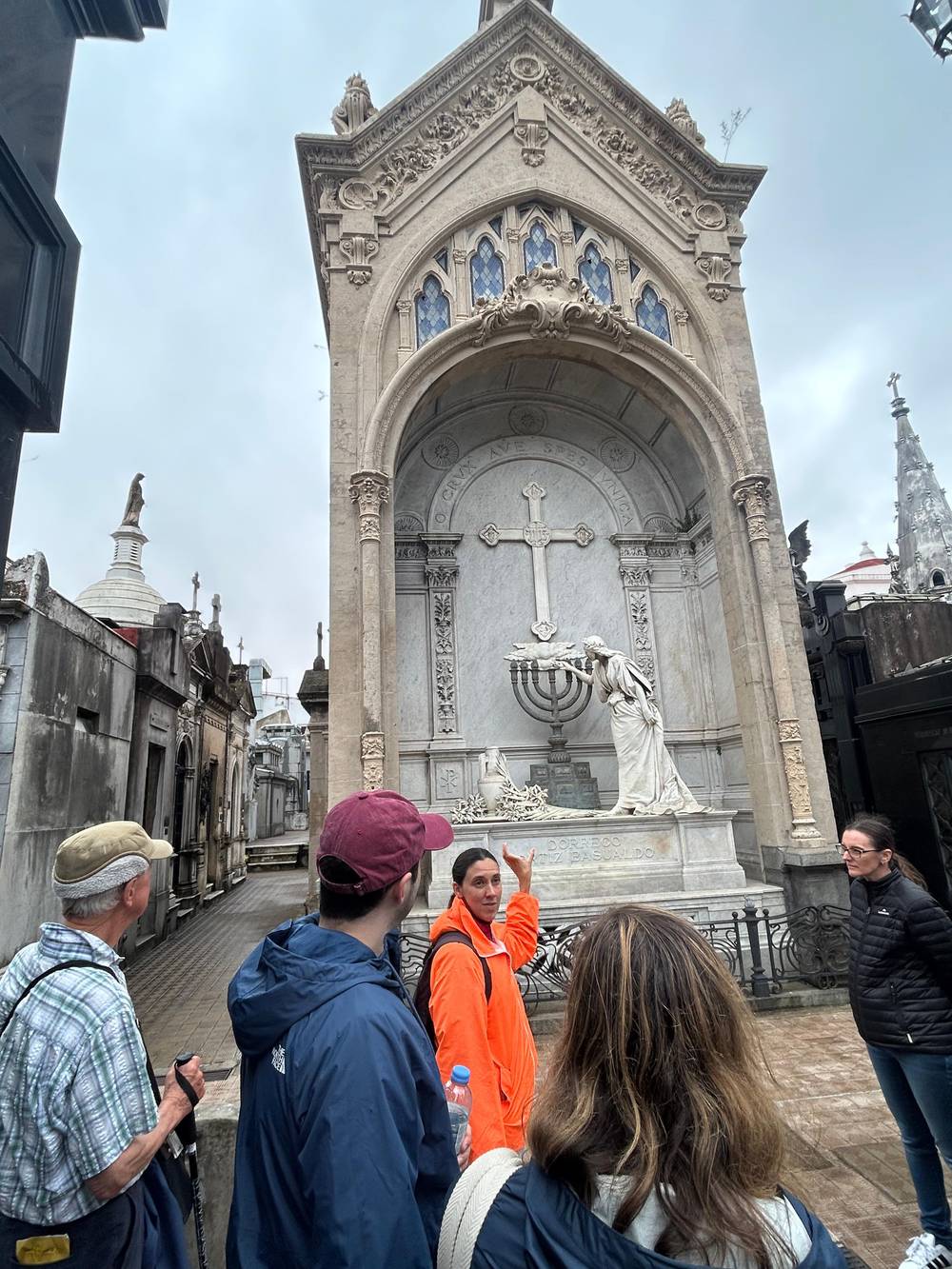
If you have booked the English tour, aim to arrive with time to spare. The listing asks you to buy the cemetery ticket before the tour, at the entrance by card or online, and the guide in an orange t-shirt waits next to the ticket booth at Junin 1760. The tour finishes back on Junin, so you are free to explore the area afterwards.
Other tours meet nearby. The small-group cemetery tour meets outside the cemetery near the cafe La Biela on Avenida Quintana, with its guide in a blue cap. A Recoleta neighbourhood walk also starts from La Biela, and a Recoleta and Retiro free walking tour finishes there. La Biela is a natural landmark: if in doubt, ask for it.
On your own, make the city tourist office on Avenida Quintana your first stop; it is staffed daily between 9am and 6pm.23 Charge your phone, fill your bottle and check the map on its Wi-Fi there, and you are ready for a five-hectare cemetery.17,24 Staff there can also point you towards the gate and confirm the day's opening hours, which saves a wasted walk on a holiday.
Your route in
Pick how you travel and see what works from the hotel.
If I am staying nearby
Walk in
Recoleta is one of the districts best explored on foot.8
If I want public transport
Subte line H
Get off at Las Heras, at Las Heras and Pueyrredon.3
If I want door to door
A licensed taxi
If I am not sure of the route
Use BA Como llego
The city route planner covers transit, car and walking.7
If I am meeting a tour
Come early to the gate
Look for the orange t-shirt by the ticket booth at the Junin gate.
Beside the walls
Colonial church
Next to the gate
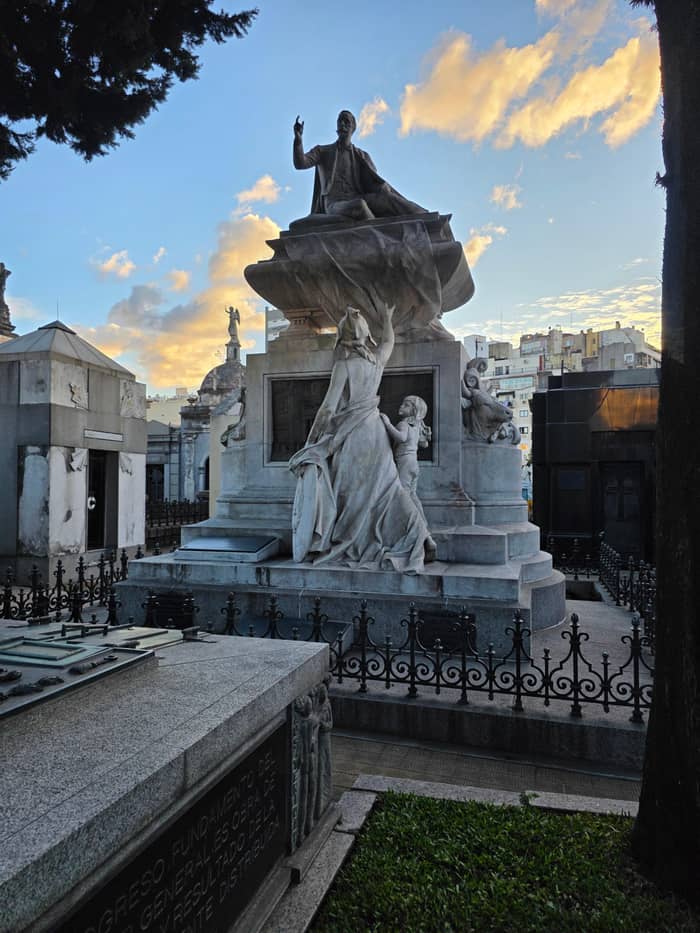
Free to wander
Old Recollect convent
City emblem
Steel flower
Things to do near Recoleta Cemetery begin next door. The Basilica de Nuestra Senora del Pilar opened in 1732, to a design by the Jesuit architects Bianchi and Primoli, and its baroque main altarpiece carries Inca ornament and silverwork from Peru.6,71 Its doors stay open late, until 22:00, opening at 7:30 from Monday to Friday and at 8:00 on Saturday and Sunday.11
Beyond the basilica stands the Recoleta Cultural Centre, in a building of 1732 that was first the convent of the Recollect friars and later a hospital, barracks, homeless refuge and old people's home.60 Today it has 27 exhibition rooms, a micro-cinema, an auditorium and an amphitheatre.61 It opens from Tuesday to Sunday, with guided visits at 16 hrs.19
Below, on the square most people call Plaza Francia, the weekend craft fair sells work made by the stallholders themselves in ceramics, leather, wood, metal and wool.64 Strictly it occupies Plaza Intendente Alvear, and the stalls open on weekends and holidays, from 10 in the morning until 20 hrs.64,20 Look out too for the huge gomero tree near La Biela, older than the city itself, 50 metres across and 25 metres tall.72
Half-day plan
Morning
Late morning
Next door, open from 7:30 on weekdays.11
Midday
Outdoor tables facing the square and the cemetery.12
Afternoon
Open from 11.00 on weekdays, 10.00 at weekends.13
Later
The steel petals close only at midnight.14
The Museo Nacional de Bellas Artes, on Avenida del Libertador, holds the largest collection of Argentine art and works by El Greco, Goya, Rodin, Rembrandt and Picasso among many others.66 It opens from Tuesday to Friday from 11.00 to 19.30, and at weekends from 10.00 to 19.30 in the evening.13 It pairs naturally with a morning in the cemetery.
Further on, across Avenida Figueroa Alcorta, the steel flower of Floralis Generica stands 20 metres high and weighs 18 tonnes.67 Its six petals open at 8am and close at midnight, a moving sculpture that has become an emblem of the city.14 On the way you pass the Faculty of Law, an imposing neoclassical building of 1949 used by the University of Buenos Aires.68
For a view, the National Library at Aguero 2502 offers a city panorama from its fifth floor, and visitors are asked to bring identification.21,70 It opens from 9 to 21 hrs on weekdays.21 Booklovers can head the other way, to El Ateneo Grand Splendid on Avenida Santa Fe, a former theatre turned bookstore with about 120,000 books and a bar on the old stage.73
Video
WANDER WALKS ARGENTINA on YouTube · Playback files load only once you tap play.
Outdoor seating offers views over the greenery of the Plaza Francia, Recoleta Cemetery, Pilar church, and the Centro Cultural Recoleta.
Getting-there kit
Restaurants near Recoleta Cemetery cluster around Plaza Francia and along Avenida Quintana and Junin, with tables spilling onto the pavement in good weather. The best known is La Biela, regarded by the tourism board as the city's oldest cafe; from its terrace you look across the square to the cemetery wall, the Pilar church and the cultural centre.62,12
La Biela is one of more than 80 bars and cafes that the city government has declared bares notables for their historic, cultural or architectural importance.74 Eating or taking a coffee in one of them is a small piece of Buenos Aires heritage in itself, and a calm way to end a visit that can leave you reflective.
If you prefer something quieter, the cafe at El Ateneo Grand Splendid sits on the stage of the old theatre, a short walk away on Avenida Santa Fe.73 For a full meal, walk a few blocks off the square into the side streets, where you will find neighbourhood places used by people who live in Recoleta. On weekends it is worth booking ahead for dinner, since the square draws crowds to the fair.
A simple half day starts at the cemetery when the tourist window opens at 9 hrs, with a guided tour or your own loop.10 Go early and you will have the quietest hour of the day among the vaults, before the heat and the groups build up. Afterwards, step into the Basilica del Pilar next door and on to the Recoleta Cultural Centre a few doors further along Junin.11,19
From there, cross to the craft fair if it is a weekend or holiday, then take a coffee at La Biela.20,62 Walking on, the fine arts museum on Avenida del Libertador and Floralis Generica beyond it fill the rest of the afternoon, and the city's own Recoleta circuit, estimated at 2.5 hours, follows almost exactly this line.75
Leaving the cemetery and turning left, the first street you cross is Avenida Alvear, which the tourism board describes as lined over seven blocks with some of the city's most expensive mansions.76,9 It is the elegant way back towards the centre, and a fitting end to a day spent among the monuments of Recoleta.
FAQ
The tourism board itinerary uses line H at Las Heras and Pueyrredon, a walk of several blocks.3
Stalls trade on weekends and public holidays, from 10 until 20 hrs.20
Sources
Visiting Recoleta Cemetery? Ask a real person here.