Art Nouveau
Rufina Cambaceres
Southern alleys
- BuiltEarly 1900s
- ByHer mother
- Look forHand on the door
Map your stop
See 41 route stops
Pick a route, then tap a marker or a stop for notes and a Google Maps link.
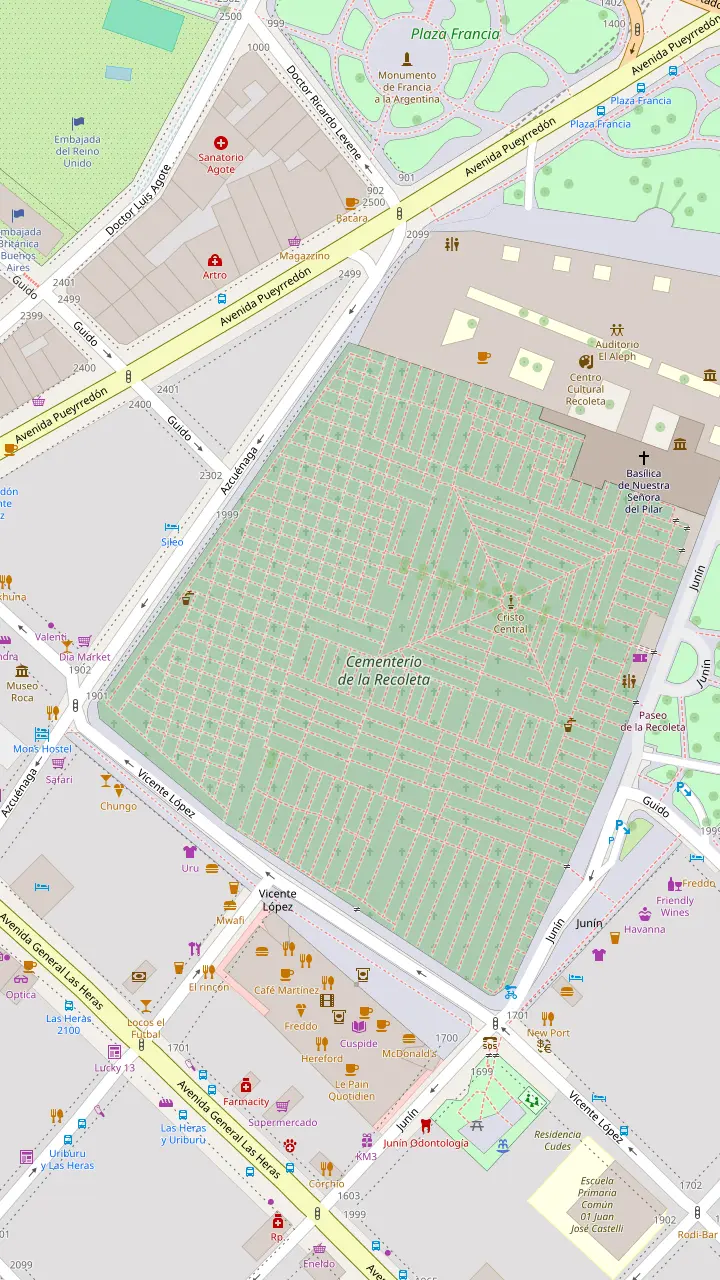
Junín 1760: the entrance for visitors, where the English tour meets by the ticket booth and free maps are handed out.
Google MapsThe vault of Luz María, the playwright's daughter who died in 1925 aged 15, and the source of the lady in white legend.
Google MapsAn Art Nouveau tomb of the early 1900s in white marble, raised by her mother.
Google MapsHer bedroom recreated inside, and a bronze of her in her wedding dress with her dog at the door.
Google MapsCrowned by a young man fighting a sphinx, carved by Léon-Ernest Drivier, a pupil of Rodin.
Google MapsThe caretaker who saved for his own tomb and statue over 30 years of work here.
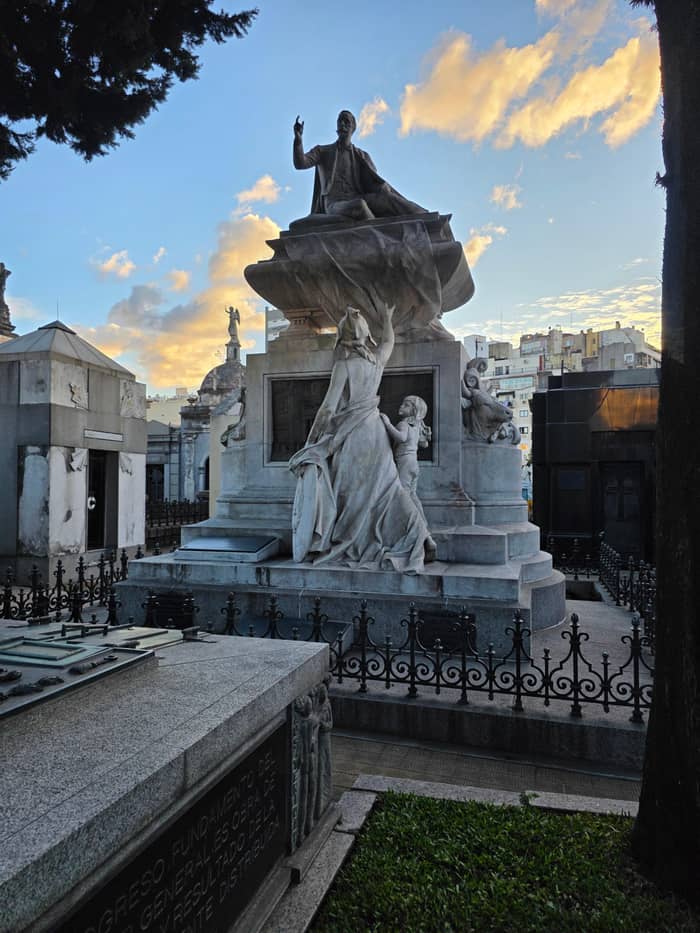
Google MapsHis bust faces away from his wife's, at her own wish.
Google MapsBlack stone, huge marble angels and Masonic imagery for the family that owned La Prensa.
Google MapsA rustic grotto-tomb of about 1866, a Romantic oddity among the marble.
Google Maps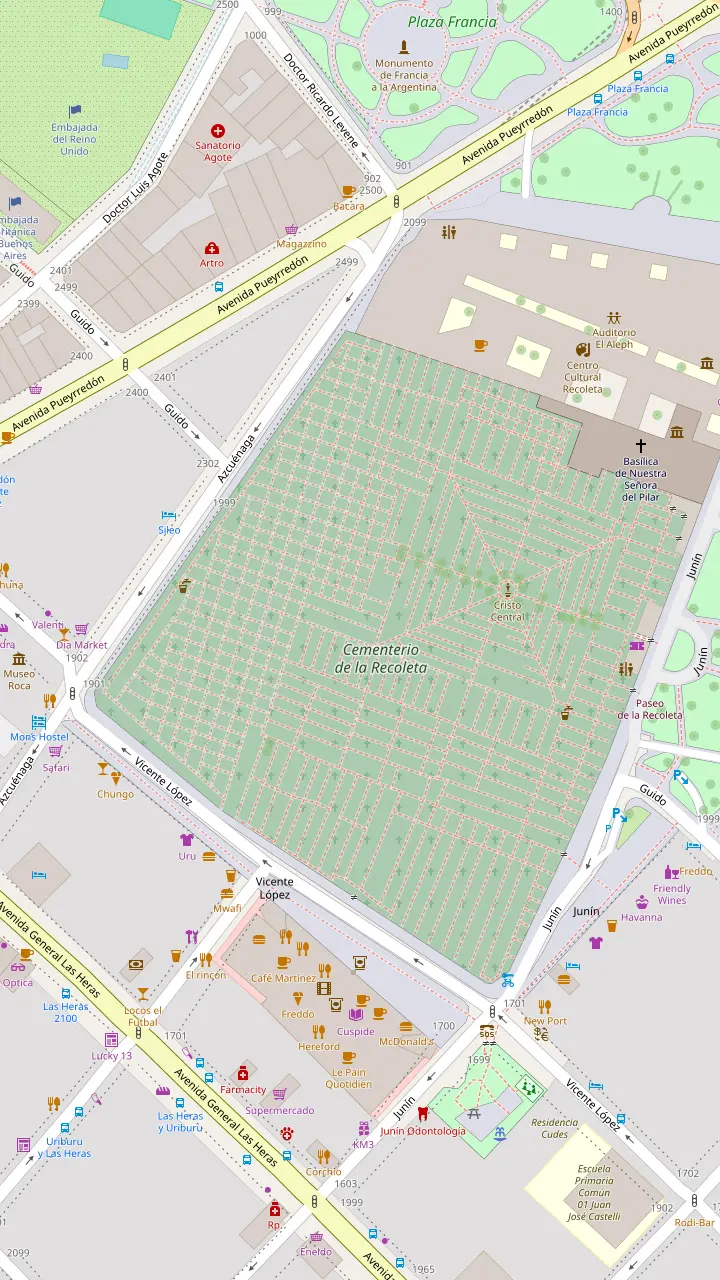
Junín 1760: the entrance for visitors, where the English tour meets by the ticket booth and free maps are handed out.
Google MapsThe bronze Christ at the crossing of the central avenues: an easy landmark to regroup at if you lose your way in the alleys.
Google MapsSimple tombs of the early republic: Cornelio de Saavedra, Antonio Sáenz and Deán Funes are honored here.
Google MapsA votive column with a naval trophy, raised by his widow Elizabeth Chitty for the Irish-born admiral.
Google MapsA compact tomb in the Egyptian mastaba manner, like that of Miguel de Azcuénaga.
Google MapsDesigned by Alejandro Christophersen; it also holds Torcuato de Alvear, the mayor who reformed the cemetery.
Google MapsThe vault of Luz María, the playwright's daughter who died in 1925 aged 15, and the source of the lady in white legend.
Google MapsThe writer's vault is among the most visited in the cemetery, the city says.
Google MapsAn Art Nouveau tomb of the early 1900s in white marble, raised by her mother.
Google MapsHer bedroom recreated inside, and a bronze of her in her wedding dress with her dog at the door.
Google MapsEduardo Rubino's tomb for the president, with figures of Liberty, Duty and Justice.
Google MapsVíctor de Pol's Masonic obelisk of 1889, crowned by a condor with open wings.
Google MapsEvita's resting place since 1976, the most visited tomb in the cemetery.
Google MapsJules Félix Coutan's sculpture of 1908: a portrait medallion and the figure of Hope.
Google MapsCrowned by a young man fighting a sphinx, carved by Léon-Ernest Drivier, a pupil of Rodin.
Google MapsThe caretaker who saved for his own tomb and statue over 30 years of work here.
Google MapsEttore Ximenes' monument to the doctor who died treating yellow fever patients in 1871.
Google MapsThe vault of the chemist who won the Nobel Prize in Chemistry 1970.
Google MapsThe family vault of the president, set where two avenues cross, with a small atrium.
Google MapsSigned by the French sculptor Mercié and raised in 1913 by the Jockey Club for its founder.
Google MapsHolds Leandro Alem, Hipólito Yrigoyen and Arturo Illia; designed by Ulrico Courtois in 1892.
Google MapsHis bust faces away from his wife's, at her own wish.
Google MapsThe tomb of the former president is among the three the tourism board names as most visited.
Google Maps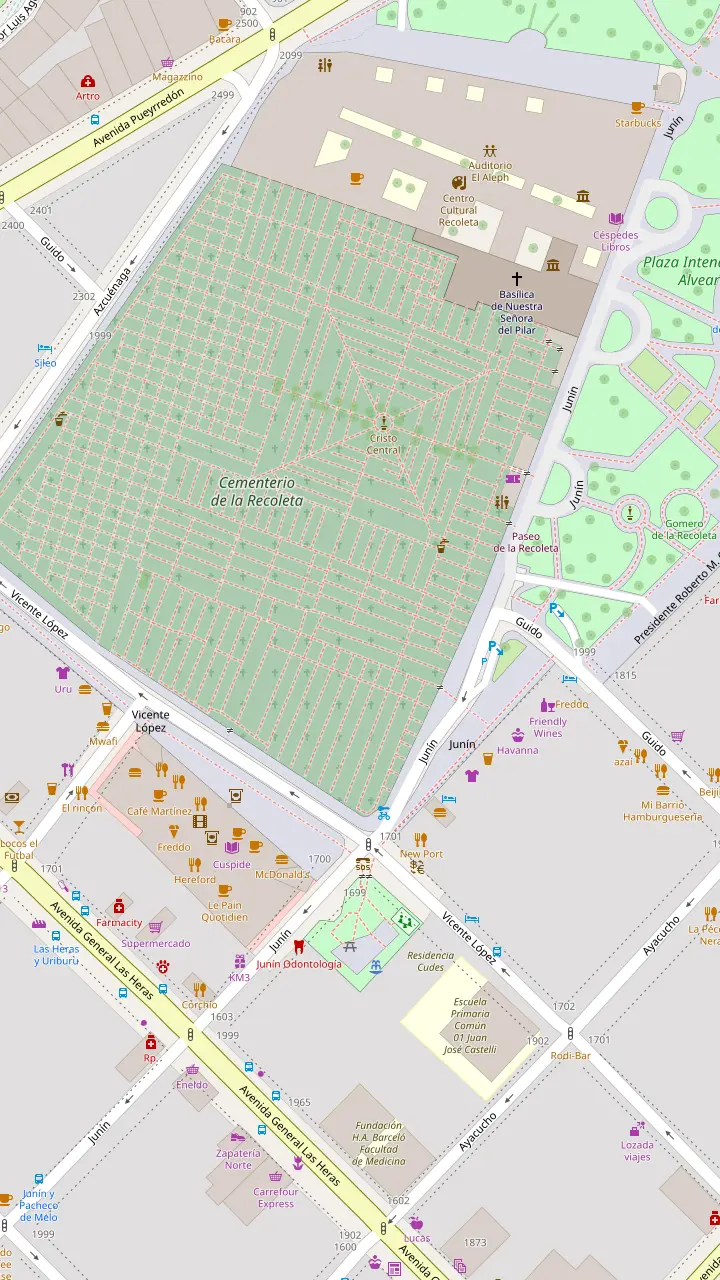
Junín 1760: the entrance for visitors, where the English tour meets by the ticket booth and free maps are handed out.
Google MapsAn Art Nouveau tomb of the early 1900s in white marble, raised by her mother.
Google MapsHer bedroom recreated inside, and a bronze of her in her wedding dress with her dog at the door.
Google MapsEduardo Rubino's tomb for the president, with figures of Liberty, Duty and Justice.
Google MapsVíctor de Pol's Masonic obelisk of 1889, crowned by a condor with open wings.
Google MapsEvita's resting place since 1976, the most visited tomb in the cemetery.
Google Maps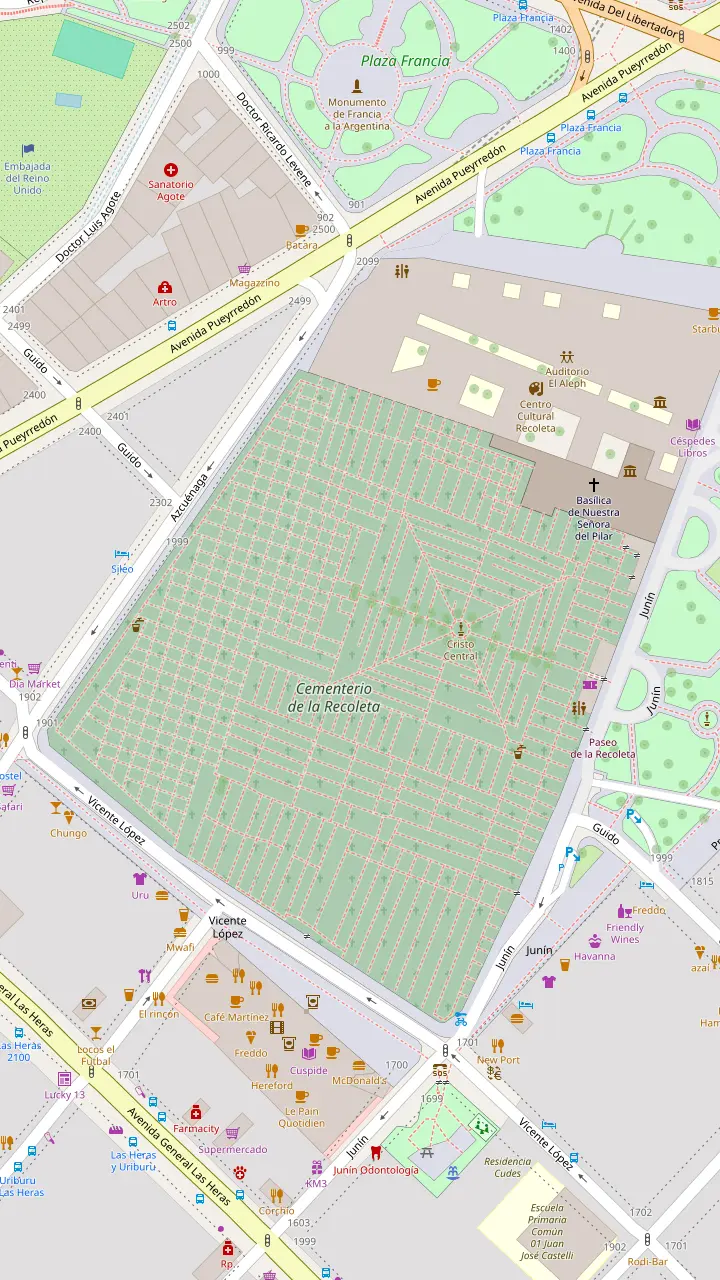
Junín 1760: the entrance for visitors, where the English tour meets by the ticket booth and free maps are handed out.
Google MapsA votive column with a naval trophy, raised by his widow Elizabeth Chitty for the Irish-born admiral.
Google MapsA compact tomb in the Egyptian mastaba manner, like that of Miguel de Azcuénaga.
Google MapsThe writer's vault is among the most visited in the cemetery, the city says.
Google MapsEduardo Rubino's tomb for the president, with figures of Liberty, Duty and Justice.
Google MapsVíctor de Pol's Masonic obelisk of 1889, crowned by a condor with open wings.
Google MapsEvita's resting place since 1976, the most visited tomb in the cemetery.
Google MapsJules Félix Coutan's sculpture of 1908: a portrait medallion and the figure of Hope.
Google MapsThe vault of the chemist who won the Nobel Prize in Chemistry 1970.
Google MapsThe family vault of the president, set where two avenues cross, with a small atrium.
Google MapsSigned by the French sculptor Mercié and raised in 1913 by the Jockey Club for its founder.
Google MapsHolds Leandro Alem, Hipólito Yrigoyen and Arturo Illia; designed by Ulrico Courtois in 1892.
Google MapsHis bust faces away from his wife's, at her own wish.
Google MapsThe tomb of the former president is among the three the tourism board names as most visited.
Google MapsThe first Argentine political and military commander of the Malvinas.
Google MapsThe founding director of a leading teacher-training school, who died in 1884.
Google MapsSarmiento's vice president, in a mausoleum of 1915 by Margarita Bonnet.
Google Maps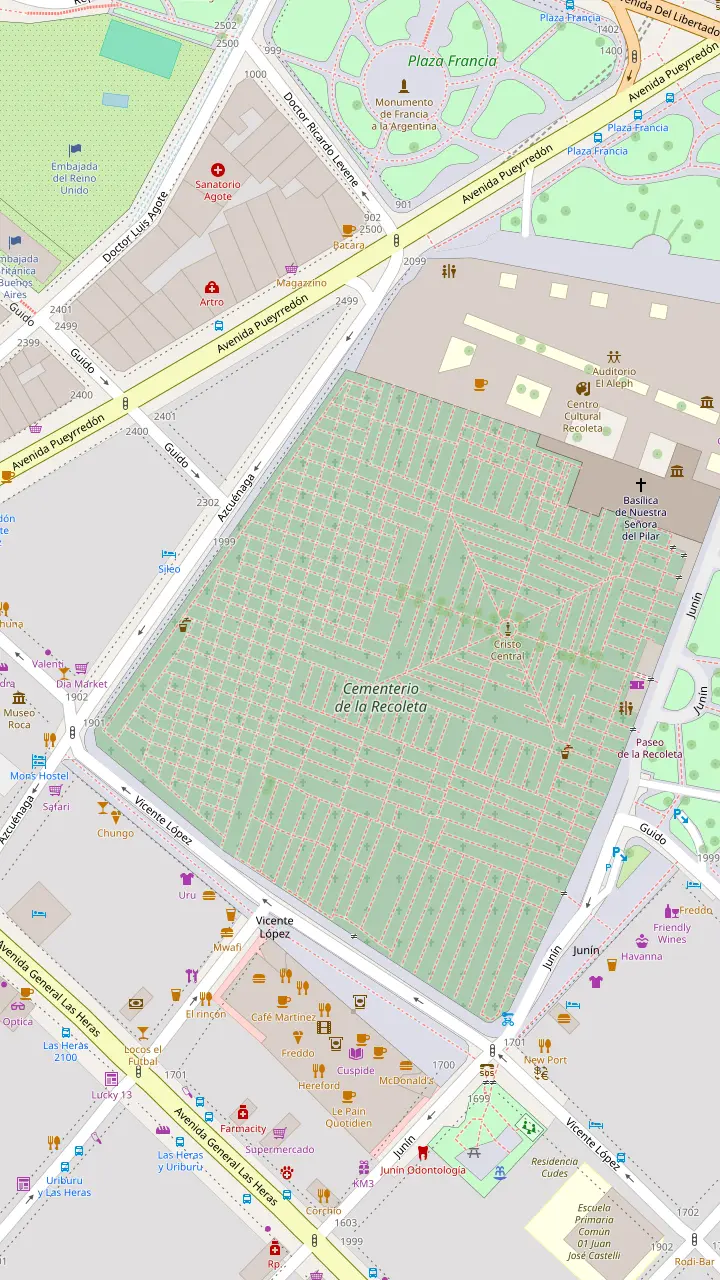
Junín 1760: the entrance for visitors, where the English tour meets by the ticket booth and free maps are handed out.
Google MapsSimple tombs of the early republic: Cornelio de Saavedra, Antonio Sáenz and Deán Funes are honored here.
Google MapsA votive column with a naval trophy, raised by his widow Elizabeth Chitty for the Irish-born admiral.
Google MapsDesigned by Alejandro Christophersen; it also holds Torcuato de Alvear, the mayor who reformed the cemetery.
Google MapsAn Art Nouveau tomb of the early 1900s in white marble, raised by her mother.
Google MapsVíctor de Pol's Masonic obelisk of 1889, crowned by a condor with open wings.
Google MapsJules Félix Coutan's sculpture of 1908: a portrait medallion and the figure of Hope.
Google MapsCrowned by a young man fighting a sphinx, carved by Léon-Ernest Drivier, a pupil of Rodin.
Google MapsEttore Ximenes' monument to the doctor who died treating yellow fever patients in 1871.
Google MapsSigned by the French sculptor Mercié and raised in 1913 by the Jockey Club for its founder.
Google MapsHolds Leandro Alem, Hipólito Yrigoyen and Arturo Illia; designed by Ulrico Courtois in 1892.
Google MapsA rustic grotto-tomb of about 1866, a Romantic oddity among the marble.
Google MapsDesigned by his son, the painter and architect Prilidiano Pueyrredon.
Google MapsSarmiento's vice president, in a mausoleum of 1915 by Margarita Bonnet.
Google Maps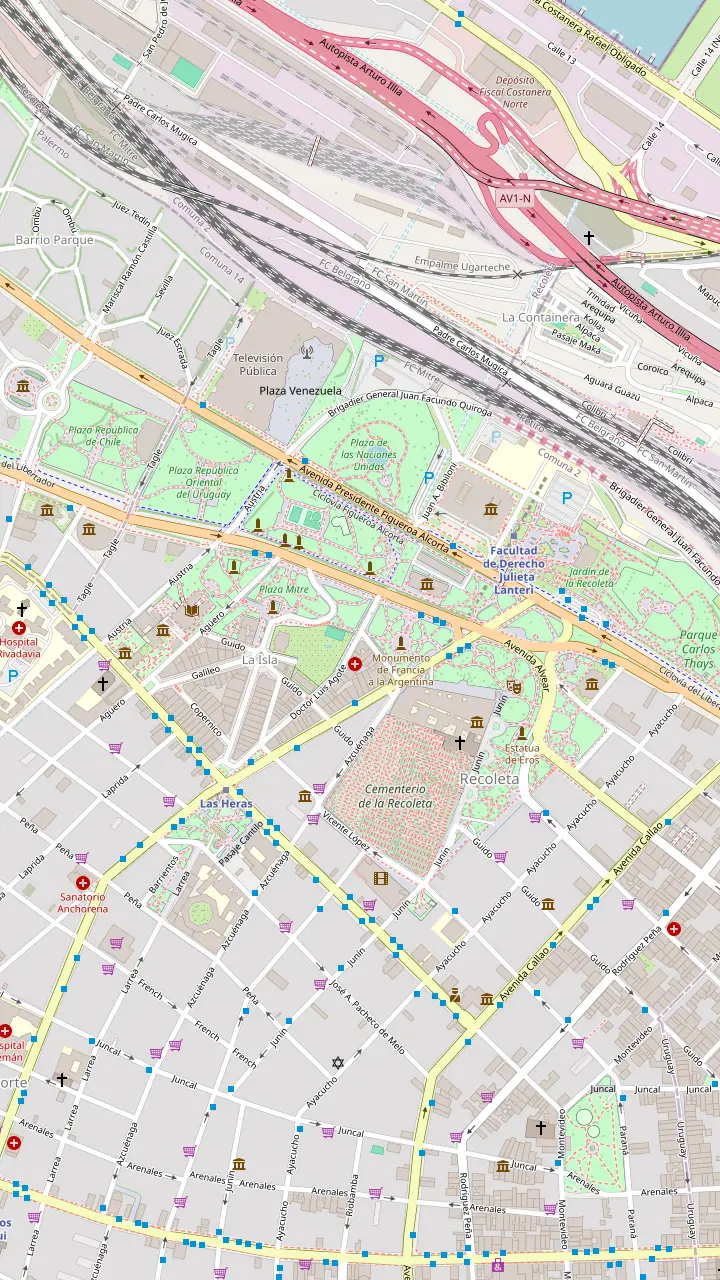
Junín 1760: the entrance for visitors, where the English tour meets by the ticket booth and free maps are handed out.
Google MapsThe white colonial church next to the gate, opened in 1732.
Google MapsThe former Recollect convent, now an arts centre with 27 exhibition rooms.
Google MapsConsidered the oldest café in the city, facing the cemetery and Plaza Francia.
Google MapsThe great gomero tree, its branches spreading 50 meters across.
Google MapsThe city's tourist assistance centre, open every day from 9 AM to 6 PM.
Google MapsThe weekend craft fair, held Saturdays, Sundays and holidays.
Google MapsNamed after the monument the French community gave for the centenary of 1910.
Google MapsHome of the largest collection of Argentine art.
Google MapsThe steel flower of 20 m whose petals open in the morning and close at midnight.
Google MapsThe University of Buenos Aires law school, a neoclassical building of 1949.
Google MapsBuilt on the site of the Perons' presidential residence, with a city view from its fifth floor.
Google MapsSubte line H, at the corner of Las Heras and Pueyrredón.
Google MapsBase map © OpenStreetMap contributors
Behind some of the vaults lie stories of grief that the city still tells. Here are the stories of Recoleta Cemetery, where to find each tomb, and what is record and what is legend.
Editorial team, recoletacemeterytour.click · Updated November 9, 2026 · A 7 min read
Main facts
The stories of Recoleta Cemetery grew out of its people. Even the city government's page on the cemetery admits to a store of curious tales, and the first it tells is a caretaker's lifelong saving for his own grave.3 When families built vaults as grand as houses, they also left their grief in stone, in statues, inscriptions and arrangements that visitors still try to read.
Some of the tales below are documented in the city's own pages, and some are legends that the tourism board passes on as legends. We keep them apart. Where a source tells a story as something that is said to happen, we say so too, and we leave out the details that turn real deaths into entertainment. Every person in these stories was someone's daughter, son, wife or husband.
That is also how to visit. These tombs belong to families, and some are still visited by them. Look at the sculpture, read the names, and take your photograph without climbing, leaning or touching. If you prefer to hear the stories from a person, our English tour weaves the best-known ones into its 2 hours.
Record and legend
| Story | On record | Told as legend |
|---|---|---|
| Rufina Cambaceres | Art Nouveau tomb built by her mother | Screams heard after burial |
| David Alleno | Caretaker who saved for his tomb | His keys at dawn |
| Luz María | Died aged 15, mother stayed in the crypt | The girl in white at the café |
| Liliana Crociati | Bedroom and bronze statue in the vault | None |
| Del Carril | Busts placed facing apart | The marriage behind it |
Each story as the city government and its tourism office record it.2,9,3,8,5,10,4,11
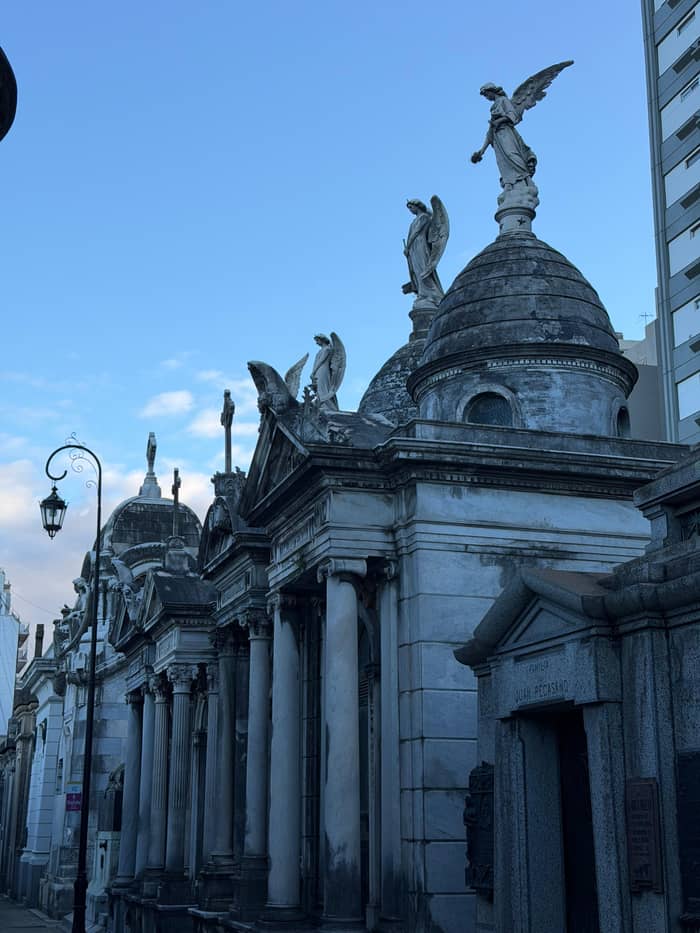
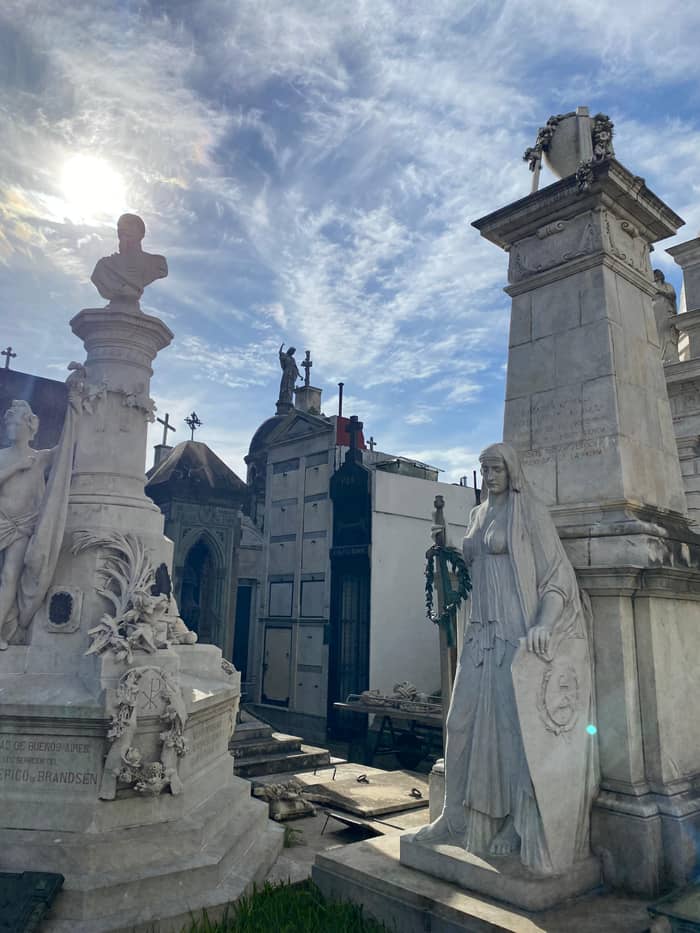
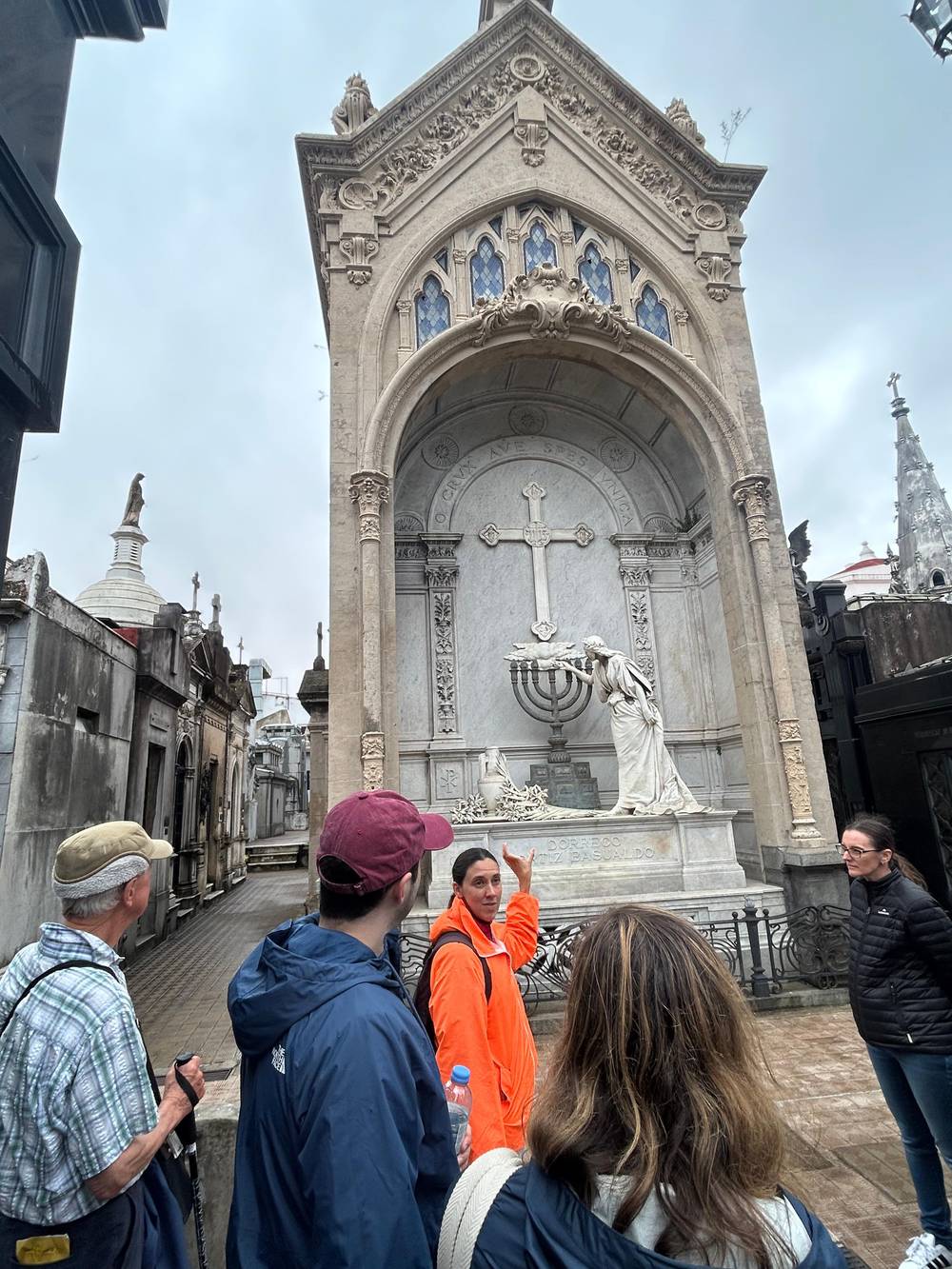
The tomb of Rufina Cambaceres in Recoleta Cemetery is an Art Nouveau work from the early 1900s, and one of the tombs the tourism board picks out by name.1 It shows a young woman in white marble with her hand on the door of the vault, a figure that seems to pause on the threshold. Our map marks it on the self-guided route and on the stories tab, in the southern alleys.
The story behind it is told by the city's tourism board. Her mother commissioned it, the board relates, once the family learned that Rufina had been laid in her coffin while still alive.2 According to the account, workers heard screams a few days after the burial, and when the coffin was opened, scratch marks were found; the explanation offered later was a coma.9
Whatever the exact truth of those first days, the tomb itself is a fact you can stand in front of. Its design, the board says, carries all the marks of a family's terrible grief.2 Read it as a memorial rather than a horror story: a mother commissioning the finest sculpture she could find for a daughter she had lost twice over.
In time
Constitution era
A framer of the 1853 Constitution, later vice president.6
Early 1900s
Her mother raises an Art Nouveau tomb.1
1925
She dies aged 15; the lady in white legend begins.5
1970s
She dies on her honeymoon in Austria.7
Every dawn, they say
The tale of the caretaker's keys.8
David Alleno worked in the cemetery for 30 years, the tourism board says, carefully saving his money for a plot of his own and a statue of himself.14 The city tells the same story more briefly: a caretaker who saved his whole life to build his tomb inside the cemetery he looked after.3 His statue shows him as the working man he was, standing among the marble of the families he served.
A legend has grown around him, as around any figure who seems to belong to a place for ever. The tourism board passes it on as a tale: some say you can still hear his keys at dawn as he walks the narrow paths.8 It is told in the same spirit as a sailor's yarn, a way of saying that he never really left.
What stays with most visitors is simpler. Here is a working man buried among presidents and landowners, in a tomb he paid for himself, in the place where he spent his life. Find his statue on the western side of the cemetery, near the monument to Francisco Muñiz, and you will understand why the city chose his story to tell first.
Plan your visit
Choose by how you like a story told.
If I want them told by a person, in English
Book the guided tour
The 2-hour English tour covers the best-known stories.
If I want a small group and time for questions
Pick a capped group
Groups on one tour are capped at 15.
If I prefer to find them myself
Use the stories tab of our map
Every tomb on this page has its own pin.
If I want the lady in white's café
End at La Biela
It is at Avenida Presidente Quintana 600.12
If I speak Spanish
Join the free hourly walk
It leaves the main entrance every hour.13
Tombs to find
Liliana Crociati was on her honeymoon in Austria when she died, in the 1970s.7 Inside the vault her parents reproduced her room as it was, and outside it they set her likeness in bronze, a bride with her dog close by.4 The tourism board's Spanish page adds that she was buried in the dress the statue shows.61
The vault stands out among its neighbors because it is not classical at all. Instead of allegories of Hope or Justice, you see a young woman as her parents remembered her, life-sized and close enough to meet your eye. Resist the urge to touch the bronze or pose with the dog: this is a family memorial, built by parents in mourning, not a mascot.
Stand back far enough to see the whole facade before taking a photograph, and let others have their turn. The vault lies in the southern alleys near the tombs of Rufina Cambaceres and Bartolomé Mitre, so you can see them all in a few minutes. Our map marks it on both the self-guided route and the stories tab.
Hear them from a guide
Compare guided cemetery tours.
Weigh up 3 options
Compare guided cemetery tours.
≈
View≈
View≈
ViewStarting prices on GetYourGuide, exchanged at the ECB reference rate. The booking page gives the exact price.
The city's tourism board tells this legend in full. Luz María, the daughter of the playwright Enrique García Velloso, died of leukemia in 1925, at the age of 15.5 Her mother, overwhelmed by grief, obtained special permission to spend nights in a corner of the crypt.10 Those facts are where the record ends and the legend begins.
In the tale, a young man sees a girl dressed in white crying in the street behind the cemetery, puts his jacket over her shoulders and takes her for coffee at La Veredita, the café now called La Biela.62 She runs off into the night and vanishes at the cemetery gate. Inside, in the first street, he finds a crypt with her name and a marble figure with her face.63
The story stays with people because it turns a mother's sorrow into a love story, and because the café is still there, at Avenida Presidente Quintana 600, a few steps from the gate.12 Visit the García Velloso vault quietly; our map marks it near the Alvear family vault. Then, if you like, take a quiet coffee at La Biela, where the tale begins.
Video
Tide Knot Travellers on YouTube · Playback files load only once you tap play.
Her parents reconstructed her bedroom within her tomb, and at the entrance placed a bronze statue of Liliana in her wedding dress, with her beloved pet dog at her side.
Respectful story walk
Some stories are told in the way statues are placed. Salvador María del Carril signed the Constitution of 1853 and served as Urquiza's vice president.6 On their tomb the couple's busts look in opposite directions: his wife left instructions for it when she died, the tourism board says, so bitter had the marriage become.11
Look up when you find it, because the detail is easy to miss at eye level. It is a quiet, almost private statement in a public place, and a reminder that the people buried here had ordinary lives behind their official portraits. The national monuments commission protects the tomb by a decree of 1979.64
A few alleys away, the newspaper-owning Paz family chose dark stone for their vault, with enormous angels and Masonic signs.37 Masonic symbols appear across the cemetery, alongside religious iconography,65 and they are part of the story too: they show how the city's elite chose to present themselves in death.
People ask whether Recoleta Cemetery is haunted; truthfully, it is a cemetery with legends, not a stage. The tourism board describes it as a labyrinthine city of the dead,66 and its pages pass on tales such as Alleno's keys at dawn as things that are said, not things that are known.8 We follow the same line.
What is on record is moving enough. A mother built a white tomb for her daughter;2 parents rebuilt a bedroom;4 a grieving mother slept in a crypt;10 a caretaker saved for decades for his own place among the people he looked after.3 The legends grew from real losses, and that is why they deserve a respectful telling.
Night tours and ghost walks are sold in many cities, but the cemetery's own visiting hours are by day, and the city lists tourist visits from 9 to 17 hrs.60 The best way to hear the stories is from a guide by daylight, then to find the tombs again on your own with our map, and to spend a moment in silence at each one.
FAQ
The tourism board passes on tales such as the caretaker's keys at dawn as stories that are told.8
She died in 1925 aged 15, and a legend grew from her mother's grief.5
Her family set a bronze bride at the door, her dog at her side.4
He saved for 30 years of work for his own plot and statue.14
Salvador María del Carril's wife ordered their busts to face apart.11
Tourist hours run from 9 to 17 hrs, according to the city.60
Sources
Visiting Recoleta Cemetery? Ask a real person here.